London Plan (Towards…)

16 September 2025 Ian Gordon has published a blog post about all this, reviewing 6 submissions. A good read. https://blogs.lse.ac.uk/lselondon/towards-an-effective-london-plan/

22 June (closing day for responses to the GLA document Towards a New London Plan). This is my personal submission. Ill health has greatly reduced my capacity and all I have been able to manage is a response to part 1 of the survey. I tried to pack in all my main concerns. (Much has also fed in to the Just Space submission which Michael Ball is finalising right now.)

It is still not too late for anyone to make their own submission – to all or part of the Towards… document. All the links you need to read it and reply are at JustSpace.org.uk/towards

1.  Paragraph 1.1: What is the London Plan?

GLA often argues that LP can only deal with town and country planning matters. That’s arguable. But this Towards… document is not constrained in this way and should have ranged across all the linked proceses: economy, housing, environment and so on.
Its scope is utterly unfit for the multiple crises we confront.

3.  Paragraph 1.3: How many homes will it plan for?

Towards… is based on the same completely mistaken interpretation of the crises which we all agree the city confronts; the belief that the affordability problems would be solved by dramatic increases in supply. This myth has been roundly debunked as a national strategy and, for London, successive London Plans have attempted to apply the remedy of maximising total output. Not only has this failed to slow the growth of rents or prices but it has led to a growing unmet backlog of need for low-rent council homes and caused great damage to other aspects of the city: diverting employment land, eroding greenspace, overloading social infrastructure and – now – threatening green belt as well. It has also eroded the stock of council homes through the estate regeneration process and permitted other disposals. Not only does Towards… fail to recognise this massive failure, but it proposes to make matters worse by chasing the impossible output target set by an equally misguided national government.

4. Paragraph 1.4: Viability and delivery

The coalition government’s decision to make ‘viability’ the make-or-break criterion for development decisions has been a disaster. While outside the GLA’s control, much more could have been done to minimise its impact, especially its impact on land values and on S106 negotiations.
New approaches are now essential: to lobby government more effectively on Right to Buy, on rent controls, on AHP budgets; to adopt policies aimed at moderating land price growth and to force land prices down to the levels at which council-level rental housing proportions can be accommodated.

5. Paragraph 1.5: What is this document about?

The Towards… document is profoundly inadequate. Ill health is preventing me from responding to later sections of this survey which I would normally want to do.

6.Paragraph 1.6: Legal and procedural requirements

I am profoundly dissatisfied with the conduct of the London Plan team since work ended on the 2021 Plan.

You should have analysed the effects of the radical policy changes embodied in the 2021 Plan. The density matrix was criticised for not being enforced. Instead of enforcing it, and thus probably damped land values, the GLA insisted on scrapping it, relying instead on boroughs to use ‘design considerations’ to develop density policies and (related) tall buildings policies. What effect has this had on densities and land prices? Other novel policies in the 2021 plan should also have been evaluated. No such analyses are visible.

A second key activity for the LP team should have been to evaluate the possible futures for London opened up by climate change and by the mounting inequalities of income and wealth generated by the London economy and housing system. The pandemic made some of these processes very visible and dramatised the inequalities experienced by Londoners, especially those in low paid and insecure jobs, in transport, retailing and distribution and those from certain ethnic groups.

A further set of futures needing exploration are the consequences flowing from Brexit.
Instead of informing London through this kind of research and fostering a better-informed and engaged population, the LP team seems to have been keeping us at arm’s length while they have conducted a one-way harvesting of opinions and experiences through the Planning for London programme. They are behaving like control freaks.

7. Paragraph 1.7: Integrated Impact Assessment (IIA)

I and Just Space and others were very critical of the GLA last time around for the many inadequacies of the Equalities Impact assessment. The Panel of Inspectors in 2019 insisted repeatedly on the GLA doing more work on this topic – which revealed in the end how regressive were many or most of the Plan’s policies. We had argued that the London Plans were dominated by property and investor interests and this tardy and reluctant analysis proved us substantially right. But nothing could be done then to deal with the criticism that the equality studies should have started at the beginning of the planning process and it bodes very badly for this new plan that the long-promised consultation on the draft IIA scoping report will begin ‘later in the year’.
The same issue arises with the SEA which should already be evaluating alternative strategies for London.

10. Paragraph 1.10: Good growth objectives

The mayor clearly feels the need to trumpet growth out of respect for the new national government leadership, and perhaps as a means of levering funds to support the ‘engine of the nation’. But his London Growth Plan is just a marketing document which appears to be written by estate agents and contains no serious analysis.

Seriously, though:
Towards… does not confront the fact that London’s economy is a machine which sucks in investment in transport and other infrastructure, pumping up central area commercial property values and city-wide house prices and rents. Thus landlords, owner-occupiers and property interests benefit from massive asset value growth while renters have seen their real incomes (after meeting housing costs) static or shrinking. This is not an economy to be proud of and it is hard to sustain in the light of the regional disparities to which it contributes.
While it is welcome that the term “good growth” still survives, this treatment of growth remains very weak indeed.

London Plan May 2025

This post is my personal observations as I get to grips with the long-delayed GLA document Towards a New London Plan, published eventually on 9 May 2025 and open to consultation until 22 June. The text may change quite often as I fiddle with it.

I’m pasting comments I get from other people on a separate page. Do join in here or there with comments or links.

We had an excellent Just Space meeting yesterday 20 May about this, built around a great summary presented by Michael Ball. Details and downloads over there. And later we have added the GLA’s own slide show and other stuff there.

Scope

This is absolutely not the high-level strategic document which LSE London group were calling for last autumn [add link if there is one] which would have posed the main choices facing London, spanning land use, transport, economy, housing and so on.

Nor is it the kind of radical response to the crises of inequality, climate and ecological breakdown which many of us have been pressing for. No special urgency is evident and the Plan — clearly already well-advanced — amounts to a complacent affirmation of events since 2016 and the promise of more of the same, intensified to pursue even higher housing output targets.

On the other hand the document is quite good in presenting housing and transport issues as integral parts of London’s planning, seeking feedback on lots of detailed questions. Most of this could have been tabled a year ago without any need to await the re-election of the mayor, and allowing time for Londoners and their organisations, universities and their research groups, to respond. But consultations close very emphatically on 22 June so only quick responses are likely.

We have thought for over a year that the new London Plan team (and perhaps the Mayor and Deputy Mayor behind them) are trying to keep the public at arm’s length and keep the whole process under their strict control. Thus the whole of 2023 and 2024 which they could have spent on co-production with communities and interested parties and on evaluating the consequences of the last (2021) Plan, they spent instead on a process called Planning for London which was a one-way harvesting of opinions, needs, demands and so forth. They thus built up a vast stash of records from events and documents which people submitted but avoided any interaction with us all. This is all at https://www.london.gov.uk/programmes-strategies/planning/planning-london-programme

One example of the narrowing of scope for public participation is that the Steering Committee for the SHLAA and SHMA has been abolished. This comprised an officer from each borough plus a representative each from Just Space, London Tenants Federation, the London Forum and the House Builders Federation (HBF). This enabled us to have at least some purchase on the crucial issues of council estate demolition which is now widely regarded as one of the worst features of London development, causing net losses of council housing in most cases, very damaging displacements of people and enterprises and putting upward pressure on rents and prices in surrounding areas. All gone. The replacement online mechanism Land4LDN is open for boroughs, developers and citizens to nominate sites for development but – so far as we can tell – we can’t search the database to see which sites have been accepted. I have written to query this. The Committee also gave us some influence on the assessment of demands and needs of distinct income groups in the housing needs/market assessment SHMA.

It’s also very bad news that the promised (and legally required) consultation on the scope of the Integrated Impact Assessment (IIA) which was expected to start now has been further postponed. This IIA includes the Equalities Impact Assessment which was so extremely badly handled last time. One of the major failings of the IIA last time was that it was done after the plan was drafted whereas it should have started from the beginning. This was one of our major criticisms when it came to the Examination in Public (hearings) and which led to the Panel of Inspectors requiring the GLA to do a lot more work. It still was awful. But we would at least have expected that this time they woud take care to get it right. (The story is all on JustSpace.org.uk Put equality and equalities in the search box.)

I learned today (27 May) that focus groups of people with protected characteristics have been meeting about the distinct housing needs of their groups. So that’s a good sign.

continues in next post 22 June

London’s growth

Just spent the afternoon at a London professional meeting & was cheered to find GREAT support for challenges to build-build-build+blame planning. Both UK political parties seen as hopelessly wrong. I gave a short talk on post-growth which got great support. Can we turn the tide?

The event was the annual briefing meeting of the London Planning and Development Forum and the Cambridge University Land Society.

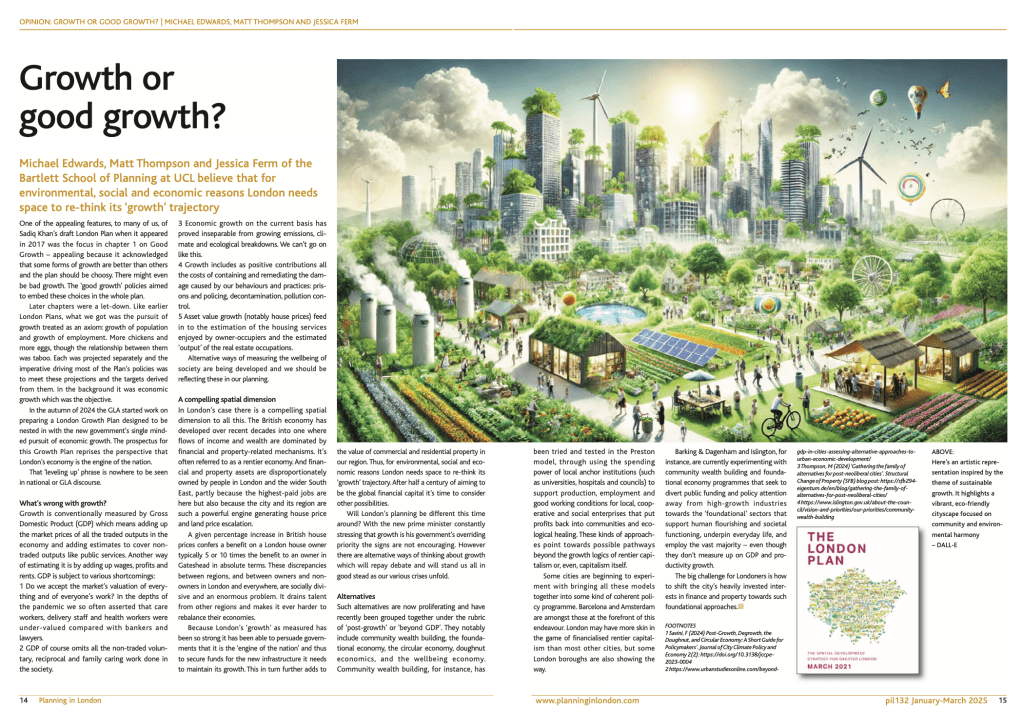
Here is an earlier article which I did with two colleagues, Jess Ferm and Matt Thompson which appeared in the January 2025 issue of Planning in London.

GLA London Growth Plan https://www.london.gov.uk/programmes-strategies/business-and-economy/mayors-priorities-londons-economy-and-business/london-growth-plan

UCL Bartlett research cluster on post-growth https://www.ucl.ac.uk/bartlett/planning/research-projects/2025/mar/post-growth-planning They are hosting an event on post-aviation futures on May 22 https://www.eventbrite.co.uk/e/airport-expansion-and-post-aviation-futures-tickets-1292559994739

Disciplines and comparative work

This blog post started as an abstract, put together in response to a plan by colleagues Susan Moore and Michael Short at the Bartlett in 2025 for a round table meeting on Critical Dialogues in Comparative Urbanism. The abstract was:

My enthusiasm for the project of dissolving disciplinary/professional boundaries in the Bartlett in the 1970s. Building student experiences to replace architecture, building and planning and knit a lot of ’science’ in the mix.

The highlights in my experience, notably the work of some individual students and the survival until [date] of the first year undergraduate module in which students studied the gestation of one London building and then took their methods on an overseas field trip

A research outcome in the Bartlett International Summer School on the Production of the built environment (BISS) which ran from 1979 to 1996, annual colloquium of scholars, trade unionists and a few activists built round an explicitly Marxist programme, leading to the International Network for Urban Research and Action INURA, founded in 1991 and still going strong as a network and annual meeting but never quite consummating its theoretical texts under the banner of The New Metropolitan Mainstream – though some of it appears in the work curated by Christian Schmid and Neil Brenner on Planetary Urbanism.

My personal effort from about 1990 to build BSP’s first new Masters programme European Property Development and Planning, initially parallelled by initiatives in Newcastle (Patsy Healey), Turin (Mazza, Ave), Venice (Folin) and … It struggled to become quorate for want of students with critical appetite but became a massive ’success’ as it later filled up with more business-oriented students from global elites and the newly capitalist countries. The international university partners faded away. UCL, BSP and many of the students got rich on the basis of what became IREP. A waste of 20 years, I think from my point of view.

The UCL School of Environmental Studies

When I joined UCL as a lecturer in 1969 Richard Llewelyn-Davies was in the process of forming a new department with this title by merging the Bartlett School of Architecture, the Department of Town Planning and various research units. Part of the project was to break out of the blinkered framework of professions, enabling teaching and research to draw on urban history, engineering (his original discipline) and other social and physical sciences. There was no particular orientation to international comparative study in this programme but the staff body included eminent people from European traditions of the Architect-Engineer: Bruno Schlaffenburg, planning officer of the new borough of Camden, Walter Bor who had been planning officer of Liverpool together with Ruth Glass, sociologist from Berlin and Duccio Turin. I was an enthusiast for all this, having just spent some years in my first job in the master planning team for Milton Keynes which was great mix of ‘disciplines’ and boundary-crossing. I wrote about the stirring atmosphere of the 1970s (and its defeat by resurgent professions) in the festschrift for historian Adrian Forty: Yes, and we have no dentists (2014).

The 1970s did not, for me, generate ideas about critical comparative study but we already did international field trips – always to Bologna – so a lot of comparative work went on, albeit without much explicit analysis.

Research: BISS

Through the 1980s, as neo-liberalism was extending its reach and penetration everywhere, some of us were developing critiques in the Bartlett International Summer Schools on the Production of the Built Environment BISS. This was an annual gathering of more-or-less Marxist and radical researchers, trade unionists and professionals in which class relations in the production process were centre-stage. Much of the work was international-comparative in scope developing explicit Marxist framings for this. It was captured in a 1985 book edited by Michael Ball, myself and others and recently reprinted. For just one or two memorable years we ran a Bartlett MSc on Production of the Built Environment, using this material. [The annual proceedings of Biss have been scanned by Jake Arnfeld and are now online at https://drive.google.com/drive/folders/1QwqDhyeiothvxt_Z5GVDiWjNhBSy2vVV]

Some of these ideas were revisited in a teach-out on Rent in 2019 and a reading group in 2021. The production-focused research continued in the work at the University of Westminster where Dr Linda Clarke moved from the Bartlett.

1990s: Roles and Relationships in the production of the built environment

The potentialities of international comparative study for teaching were most explicitly developed in a module which we ran through the 1990s, compulsory for all students in the Bartlett (now a faculty comprising departments with names like architecture, planning, construction). Fortunately it is well written up and preserved online though the journal in which it appeared is dead.

Research: INURA

As the BISS was wilting in the 1990s ascendancy of neo-liberalism, we launched a new network in which activism was meant to be as important as research: The International Network of Urban Research and Action INURA. Like the BISS it was headquartered in Switzerland and has annual meetings, though without its own scholarly publication. Its ‘method’ consists of a few days of listening and exploring in a host city with local activists, interspersed and followed with informal workshops which engage with the research and theoretical interests of participants. An attempt at publication of a systematic study of multiple cities has foundered as the unruly crowd of contributors failed to meet the high ambitions of the main leaders, notably Christian Schmid. Under the banner of The New Metropolitan Mainstream, some of it appears in the work curated by Christian Schmid and Neil Brenner on Planetary Urbanism. Most of the work sits like an iceberg on hard drives around the world. It contains valuable attempts to define variables and episodes common to multiple cities and thus generate principles for critical comparative study.

EPDP

My personal effort from about 1990 to build BSP’s first new Masters programme European Property Development and Planning, was initially paralleled by initiatives in Newcastle (Patsy Healey), Turin (Mazza, Ave), Venice (Folin) and ?? It struggled to become quorate for want of students with critical appetite but became a massive ’success’ as it later filled up with more business-oriented students from global elites and the newly capitalist countries. The international university partners faded away. UCL, BSP and many of the students got rich on the basis of what became IREP. A waste of 20 years, I think from the point of view of developing critical comparative analysis.

I thought of adding instances of students, and student dissertations, which have represented the achievement of these aspirations over the years. F

Adesope, G. (1993) Public-private relations in two major station redevelopments MPhil, London UCL compared the King’s Cross railway lands with Paris Rive Gauche, both ‘regeneration’ schemes above and around major stations and both hit by the same crash of the speculative office markets. The thesis examined how the London project evaporated while in Paris the municipality just kept on building decking, running up mounting public debt but harnessed the new Biblioteque Nationale to occupy some of the space.

Reference list

Edwards, M, Campkin, B and Arbaci, S (2009) Exploring roles and relationships in the production of the built environment Centre for Education in the Built Environment (CEBE) Transactions 6, 1, 10.11120/tran.2009.06010038 http://discovery.ucl.ac.uk/15579

Edwards, Michael (2014) “Yes, and We Have No Dentists.” In Forty Ways to Think About Architecture: architectural history and theory today, edited by Iain Borden, Murray Fraser and Barbara Penner, 280 pages. London: Wiley, ch 28, 2014. http://eu.wiley.com/WileyCDA/WileyTitle/productCd-1118822617.html
[
 e-print Edwards for Forty ]

Ball M J, Bentivegna, V, Edwards, M, and Folin, M, Eds (2018) Land Rent, Housing and Urban Planning: a European Perspective Reprint of 1985 book in Routledge Revivals series. https://www.routledge.com/Land-Rent-Housing-and-Urban-Planning-A-European-Perspective/Ball-Edwards-Bentivegna-Folin/p/book/9781138494435

2022, Michael Edwards, Harvey’s Urbanization of Capital: why it helped me so much, in Camilla Perrone (ed) Critical Planning & Design: Roots, pathways, and frames, pre-print as accepted: edwards-on-harvey-v1   Book now published. Details and ordering at http://link.springer.com/book/10.1007/978-3-030-93107-0…

BISS. https://drive.google.com/drive/folders/1QwqDhyeiothvxt_Z5GVDiWjNhBSy2vVV

London Plan debates may be starting

Today 26 June 2023 I went to the first London Plan event at City Hall which has been open to organisations and people who say they want to come. Here are some jottings while they are fresh in my mind. My take-away was that it felt like a milking parlour with us as the cows.

Preamble

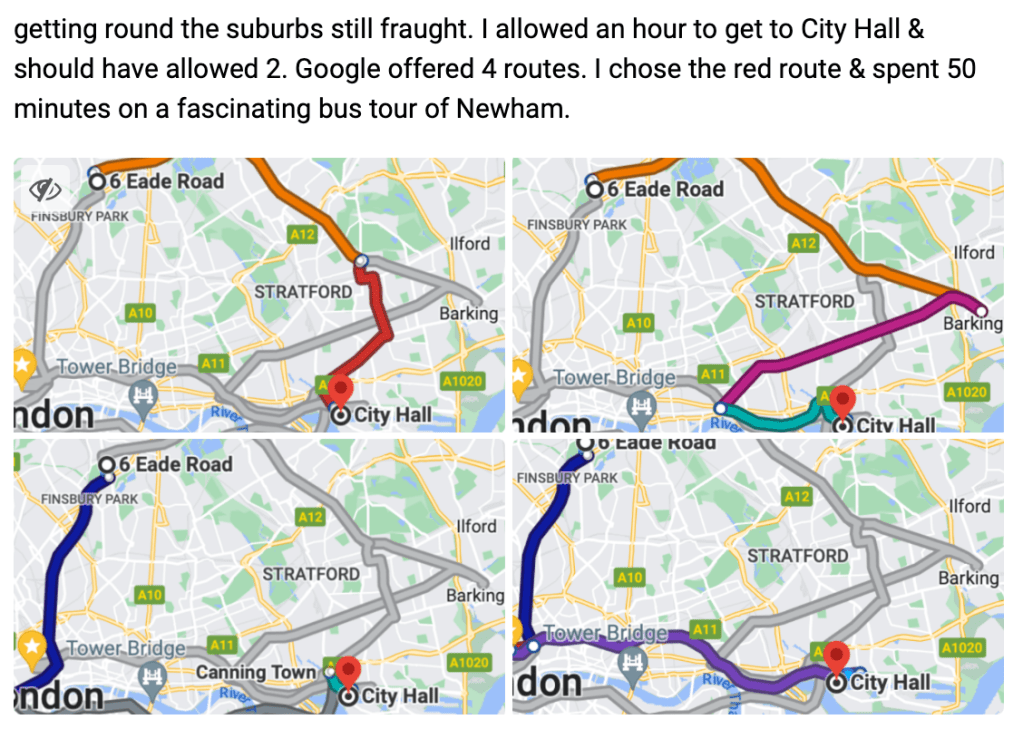
Just getting there for a 0900 start was a challenge. I put that on Mastodon:

Happily various people spoke about the urgency of improving suburban public transport, especially orbital/transverse, and especially buses (speed, cheapness, frequency and reliability).

I thus arrived late and was placed in a holding formation at table 10 awaiting the next round of managed small-group discussions. The room was in cabaret layout with each table holding 2 or 3 GLA staff, a facilitator from 2CV, not a small French car but some sort of consultancy. (Much though I dislike this sort of outsourcing, the individuals I met were rather good at their job.) Each table had 6-8 Members of the Public. Actually we were ‘Stakeholders’ I think and everyone I encountered was ‘representing’ some organisation or other – though in a few cases they sounded like campaigns with just one member. (sentence deleted as perhaps off-putting to some potential participants)

Context

The context is that the last London Plan was a bad plan and is now very old. Drafted in 2016, it would have been adopted in 2020 (though it was pushed into 2021 by some rather infantile nit-picking from the Secretary of State) and has in many ways become even more irrelevant to London’s real needs as a result of the pandemic, the crazy slither into fresh austerity and now a recession wished on us all by the ‘government’.

The City Hall planners could and should have got down to some urgent work to get a new plan under way but the Mayor apparently decided that no start should be made until after the next mayoral election in May 2024. So what were they to do? Tricky for the planning team, most of whom were anyway new recruits, following a wave of retirements.

Just think what they could have done! They could have fostered and facilitated the lively public discussions which take place among London’s many publics, professional and research networks. London and every one of its 33 boroughs has loads of networks of people studying, campaigning, watching and lobbying on housing, greenspace, transport, conservation and other issues and arching over all that the impending catastrophes of climate and ecological breakdown. A lot of politicians and planners, including some in City Hall, treat all this with disdain or contempt, dismissing us all as ‘usual suspects’, unrepresentative, NIMBY middle class owner-occupiers defending our private and class interests. Insofar as there is any truth in this the constructive response would be to support and foster the widening of participation to bring in more of the ‘hard to reach’ groups whose absence enables us to be dismissed as unrepresentative. A bit of this took place in 2000-2008 but none since then when Boris Johnson took over. The Assembly did listen recently to some more diverse experiences, but not the GLA planning teams.

Despite calls from our Just Space network, and from others, there has been no GLA engagement with citizens in London until now, beyond an open call to submit documents over a year ago (did anything arrive?) and some meetings in autumn 2022 which were invitation-only so that the GLA could ensure ‘representativeness’. The whole process is now described online on the GLA’s web site and some more detail has been prized out through an FOI by Prof Ian Gordon of LSE [ download PDF ].

They certainly weren’t catching up with the long-overdue process of monitoring the successes and failings of earlier London Plans. Peter Eversden of the London Forum has been tenacious in pointing out that we have only just had the Annual Monitoring Review 17, two years late, and there is no sign of numbers 18 and 19 which would bring us up to date and begin to tell us what has become of the policies in the ‘new’ 2021 plan.

They also weren’t (visibly) exploring the widening range of of possible futures opening up before us, notably the accelerating climatic and ecological catastrophes, the further stoking of income and wealth inequalities by governments in Britain and elsewhere. They could also have been exploring some of the policy options which London might adopt or be enabled to adopt: a degrowth strategy, a rapid curtailment of air travel, a switch from maximising total housing output to a focus on maximising the social housing stock, a moratorium on the felling of trees, rent controls for housing, no more Crossrails to boost central London property values and suck in workers from ever further afield. So much needs exploring.

Today’s discussions: In the five hours 0900-1400 they had programmed four cycles of discussions at 10 tables. Each table had assigned topics so the hosts could harvest four sets of comments/debates and there were multiple members of the planning team there to do that, plus some audio recording. There was no recap or summing up or reporting to plenary so none of us knows what happened except in the tables we were at. Some of the discussions I was at were fruitful and could have extended and developed into really useful deliberations but that was not to be. It was not so much harvesting as like a milking parlour with us as the cows. And we never got lists of participants (even lists without emails) so participants can’t pursue what in many cases could have been fruitful new alliances.

The distilled topics for each of the ten discussions clearly represented a great deal of work by the planners and perhaps by the consultants. It was all embodied in a slide show which ran on automatic all day. Many of the slides had a lot of important text but it was impossible to read because they each had about 3 seconds of exposure. I have asked to be sent a copy of the slide show and hope they will publish it.

[Five hours of concentrated discussion really call for a meal break. We had unlimited tea and coffee plus chilled croissants and fresh fruit midstream, but I was weak with hunger and left with stomach ache. I can’t have been alone.] [Later: those booking for the whole day on 13 July will get, not just a lunch break, but an actual lunch: good news.]

Substance

Building standards for decarbonisation. As with all the chosen topics, staff had distilled a number of questions to pose to the table. On this topic we discussed whether all new building should be required to match passivhaus standards (no dissent here and some acceptance that higher build costs would end up depressing land values, not inflating house prices) and then the much thornier issues of retrofitting the inherited stock. There were calls for a big urgent programme (no mention of ‘mission’ but it easily could have been) but others emphasised the complexities of customising retrofit works to the particularities of each building and each occupier: condensation and mould can flourish if draughts are reduced and a household can’t afford to maintain enough heating and ventilation. That linked to some discussion of heating networks charging systems and the contradictions of pricing as a means to reduce energy use. [I asked if GLA were in touch with the London Tenants Federation on this because they have been gathering experiences on estates. Answer: no. ] The table included 2 passionate campaigners from Ealing, both carrying printed flyers, one calling for a ban on tall buildings & citing research by Prof Phil Steadman and colleagues at UCL, the other protesting the impermeable paving of front gardens, now being given a boost by the cost and difficulty of charging electric cars while they are on the highway.

Reducing car use. This became a rather general transport discussion and suffered from the absence of any petrol-heads: there was nobody to champion the “freedom” to drive and only weak representation of that criticism of LTNs, ULEZ etc on the grounds that many poor / working class people need their cars and vans for work and can’t afford to replace their old vehicles. There was strong expression of the need for major improvements in suburban public transport, especially orbital, and thus especially buses. This came strongly and well from various quarters – perhaps reinforced by the struggles many of us had in getting to the new City Hall. Interestingly we had a person from various central London freight/deliveries campaigns being mounted by BIDs, landowners and traders. He was very informative about the problems arising from poor management of kerbside space: so much of that space now diverted to bus and bike lanes, alfresco dining and micro-parks that deliveries become impossible and/or more costly. Some of these problems can be got round (as in some continental cities) by confining deliveries to an early morning period when pedestrianisation is suspended but it’s complicated and deals only with a few of the conflicts… Silos and blinkers operate here with the division between National Highways, TfL roads and borough roads, leading to problems in – for example – having a green-for-all-pedestrians phase at more lights. [An aside: doesn’t anyone study red routes, now many years old, where traders needing kerbside deliveries or customer pickup of heavy goods have now mostly closed or moved, to be replaced by services (nails, betting, cafes) except where there are frequent side turnings where brief parking is possible. Holloway Road and Green Lanes are my local main roads where a modus vivendi seems to be established.] Not my subject, all this stuff.

Mixed uses and mixed places was the third topic in which I found myself. There was some quite good discussion on the positive value of 15/20 minute-city campaigns (though impatience with fussing about the actual number, given the diversity of densities in London). I pointed out the regrettable loss both of “lifetime neighbourhoods” and “reducing the need to travel” between the 2016 and 2021 London Plans. GLA efforts to combine uses within individual buildings got rather little attention. The link with pandemic experience was well made.
I think it was in this session that we told the story of how the supermarket chains made such a big push to get themselves an exemption from normal rules in the 2021 London Plan as they roll out their metros, locals and minis: freedom to use big delivery trucks without building off-street loading bays. This naturally generates a lot of fury among citizens – but it must help to reduce the need to travel.

What else happened? My notes are poor.

The event failed to grapple with the huge reduction of planning influence over uses (from PDR and changes to the Use Classes Order). It also failed to mention the main London Plan innovation of 2021: the Agent of Change Principle. This tries to prevent new (normally residential) users moving into an area and later suppressing pre-existing uses on grounds of noise or other nuisance. Those complaints had caused the closure of music venues, pubs, some industries. The policy puts the onus on the developer of a new use to design and pay for whatever measures are necessary to prevent the new users from being annoyed. Does it work? Is there any monitoring?

Comment

The second (and last?) of these open events is on July 13th and you can apply to go from the Planning for London hub page where they also promise to post results and findings. The topics next time are the economy and housing. Shall we be able to debate degrowth, alternatives to the Global City, versions of ‘levelling-up’ which take the pressure off London and its wider region? Later: I have booked a seat and the booking page includes this list of topics (ignore my ticks):

Or is it going to be left to citizens’ own organisations and to universities to host these events in the coming year? Watch this space for personal comments and also the web sites of
Just Space
The London Forum of Civic and Amenity Societies

Another aside: the new City Hall is a pretty grim place, quite apart from its location. It has none of the elegant simplicity of the best Foster architecture (e.g. Stansted as it was) but feels like an arbitrary envelope with the structure bodged to hold it up. I suppose it should get some credit for being a new use for a useless abandoned marketing ploy by Siemens. The main chamber is more paranoid than the previous one with high armoured glass screens separating the Members and active guests from the threatening general public and no porosity between the two. While the former public gallery had one power outlet for the public, the new one appears to have none. It’s not welcoming. The security arrangements are even worse than they were at Potters Fields and the queue for a major event would have no shelter from the elements. The surroundings are mown grass of the most boring kind. Some biodiversity net gain would be very easy to secure. How about allotments?An orchard? Pergolas for shade as the climate heats?

A personal comment. It was good to meet some old friends who once were our students at UCL, notably Kate Gordon, once of FoE London and now working in the London Plan team, and Ilinca Diaconescu now head of policy at London Gypsies and Travellers. Carmen Campeanu is now in GLA planning working in development management on stage 1 and stage 2 reports on the applications referred to the mayor. And to prove that I can’t be accused of turning all my students against capitalism, Liz Mason (née Harris) is now head of planning for Canary Wharf Limited. That morning we had heard that HSBC was to leave its tower at CW and return to the City and Liz agreed it was a big gap to fill. She seems to relish the challenge of finding new uses for Canary Wharf

digression: clearing my disc, I found this biographical fragment from 2005 with lots of Italy in it. https://michaeledwards.org.uk/2005-a-biog-fragment. NB the London Social Forum, referred to there, does not exist any more.

Valuing Harvey

Old INURA friends Camilla Perrone and Giancarlo Paba started editing a book in which each contributor would write a chapter about a book which they had especially valued and how it had influenced them. During the gestation of the book Giancarlo died and now the project has become, in effect, a tribute to him – especially for those contributors who had been his students at the University of Florence. The book is called Critical Planning & Design: Roots, pathways, and frames.

I have contributed a chapter about David Harvey’s The Urbanization of Capital, 1985. The text I have submitted is here for those who would like to read it. This is in accordance with the publisher’s contract. The book is now out. Details are at http://link.springer.com/book/10.1007/978-3-030-93107-0…

Brexit, for a friend abroad

Friends in various parts of the world, busy with their local or global issues, sometimes end their messages by asking what on earth Brexit is about, how they can make sense of it, how something so bizarre could have happened. Feeling that they had not been paying enough attention perhaps, they ask for clarification. An email from a friend in Athens triggered this reply: an open letter.

In my daily life in England I rarely have to discuss Brexit or give an account of my views about it but I do feel a need to get something down in writing, if only for friends abroad. It’s tricky because I’m ambivalent on some dimensions of the issues, while others —especially around the Labour Party— have become toxic.

I don’t find it easy even to start. Perhaps I’ll begin with the EU as I experienced it in recent decades. I have always been ambivalent about the EU because it has so many attributes of the capitalist state, many of them built in by design from the outset but others added later as part of the rise of corporate capital and the neoliberal mental apparatus it sponsors. On the other hand the EU embodied from the first some features of historic compromise between capital and labour —some attachment to welfare systems, labour market regulation, the protection of reproduction and of environment. Like any other state apparatus it was the arena for struggles between social forces, for compromise and so on. I never really studied it so these are amateur comments. Increasingly, via the later treaties, the EU became more of an explicit instrument for capitalist liberalisation but it always retained positive support for education, research and exchanges —Erasmus, Socrates and so on— which I was most directly involved in. It enabled thousands of us to collaborate, to travel in doing so, to be students across the continent, to expand perspectives and build networks —even quite critical networks. Those wonderful EU functions still go on, of course, except for the British. In hindsight I realise how elite it all was/is. Bus drivers and cleaners and care workers don’t get to do international exchanges; school groups travel to some extent but I think it’s very limited in extent and depth: trips rather than living abroad. So the dissolved frontiers were essentially for elites, elites of left as well as right, but all part of the reproduction and consolidation of class.

[Fetches a glass of Rioja.] ***************

Where did the Brexit idea come from and how did it move from being a freak/fringe position to a contender for actual implementation? I’m no expert on this either. What seemed important to me was that some malign operators were shrewd enough to see a whole raft of disparate grievances, spread across social strata and geographies, which could be herded like a menagerie behind the Brexit campaign. Partly this drew on the internal contradictions of the Tory Party as representing (rather badly) big corporate business in productive sectors, PLUS (rather obediently) the banking and finance sectors (recently the geese with golden eggs) PLUS a lot of conservative people in various social strata, mainly nostalgic and/or xenophobic. Similarly the Labour Party had become very dysfunctional, less and less representative of (and composed of) working class people, estranged in large measure even from trades unions, often itself racist and never integrated with social movements in environment, housing, migrant rights or sexual politics. So both those political parties had a lot of potential voters who could be diverted by the blandishments and lies of the Brexit campaign.

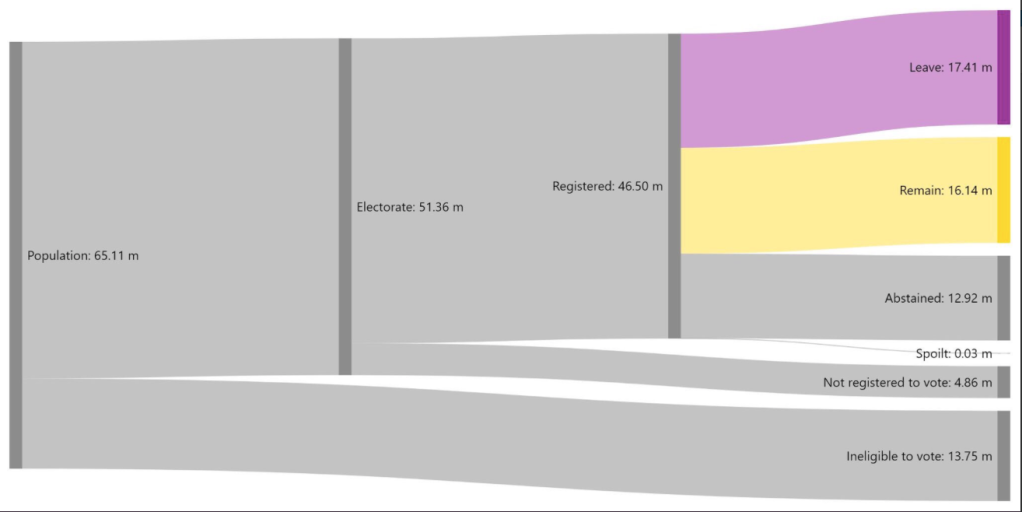
A big issue in the UK (at least in England where I live) is how the referendum vote in 2016 should be interpreted.

Image from Billy Bragg

I’m very much persuaded by Lisa McKenzie’s studies in the Nottinghamshire coalfield from which she concluded that working class people’s votes for Brexit were primarily votes against a status quo which had abandoned them, trashed their economy and culture. In a more egghead vein I was also much impressed by my friend Jamie Gough’s argument back then that the Brexit votes of many working class people (in the popular sense) were substantially votes against the state, local, national and European, as useless at delivering for them. He also argued that blaming migrants for shortages of homes, jobs and services was a quite understandable response in the absence of any alternative political analysis and offer within formal politics.

Part of what went wrong in all this was a kind of guilt trap: it has been commonly held on the left that a lot of the working class Brexit vote was a wake-up call by abandoned, unrepresented, people for an alternative politics. OK so far: I’m sure that’s largely right. But those of us who consider that leaving the EU would be against the interests of most of those voters weren’t supposed to say so because that would disrespect the working class or disrespect democracy. Neither Corbyn nor anyone else picked up the challenge of developing a strategy for socialist approaches to Britain’s problems inside the EU, working alongside allies across Europe. A lot of us were politically homeless and the pressures on Corbyn and co led them to pull away from their clear Brexit position and hold out the prospect of a fresh referendum. This is widely credited with much the blame for Labour loosing the 2019 election. I don’t know, but certainly it was all disastrous.

The campaigns in opposition to Brexit, between the referendum and the implementation were, to me, deeply toxic: an impossible coalition of Liberal Democrats (the much hated junior members of the ‘coalition’ government), some Greens and miscellaneous dissenters form the main parties. I went nervously on one of their marches and found the patriotic waving of blue EU flags as offensive as patriotic waving of national flags. Who could be patriotic for the Berlaymont?

The strong support for Brexit among the supporters of the Tory party is a different kind of mystery. Clearly there were property-owning and business owning people in England who stood to loose a great deal from the Common Agricultural Policy or other aspects of Brexit but who made themselves visible leavers by erecting huge posters on their land beside highways or in their shops, echoing the Countryside Alliance against a threatened ban on fox hunting of a few years earlier. That was alongside the much more sinister presence within the Tory party of the kind of vulture capitalists, eager for chaos and ready to pick the bones of the welfare state if its death could be arranged.

The greatest practical problem for me was maintaining friendly relations with the few people whom I had always regarded as real political allies but who were pro-Brexit on the grounds that the EU was, or had evolved into, a hideously neoliberal enforcement machine (true) which we should quit so that, led by Jeremy Corbyn, John McDonnell and others, Britain could begin to develop in a socialist direction. This was in 2016/17 when the Corbyn project was going well and this optimism was plausible. Why didn’t I share that perspective, since I was (and am) very pro-Corbyn/McDonnell?

I think for two reasons. Firstly I do think that the modern nation state tends to be a horrible thing & the more it can be diluted and constrained by supra-national powers the better. I guess I keep hoping that the kind of humane consensus which has flourished in the ILO, WHO and some branches of EU activity can help keep nationalists & xenophobes in check. Added to that, most of my friends across Europe (and friends in London irrespective of national origins) were devoting their energies to anti-capitalist work. So a position like Varoufakis, seeking pan-European alliances to challenge and supersede the neoliberal elements in the EU was appealing. The satisfactions of transnational campaigning which I have experienced in INURA (the International Network for Urban Research and Action) and now see in the European Coalition for Rights to Housing and the City are great, and perhaps too beguiling.

So there we are. Out of the EU.

Undoubtedly this will bring, indeed was always intended to bring, serious further declines in living standards for working class people in the UK, occasioning further inequalities, collapse of investment in most sectors and attrition of protections on working conditions, environment and rights. This is all under way in the first month. Impacts in Ireland and in other places for which the UK was an important export destination (mainly German I think) will also be painful. There is a recent and again excellent analysis by Jamie Gough of why so many sections of ‘UK capital’ are supportive of Brexit or are keeping quiet while they construct ways around it.* All of this will of course combine with the long downward haul of UK austerity through much of the last 20 years and with the disastrous damage caused by the Johnson regime’s mismanagement of the Covid19 pandemic. Rival blame games are going to be very unproductive. I have no idea whether we (and who is the ‘we’, for god’s sake) can forge any progressive way through the mess. At a London level it does seem to offer some glimmers of hope for insubordination. But that’s another story and needs discussion among friends, discussions which are so elusive in this lockdown.

Meanwhile back to Brexit. Keith Flett’s blog today draws attention to 2 new articles by Perry Anderson in the London Review of Books which I must read because he is a real wise owl. (They appear to be outside the paywall.)

The text above is not a coherent story, much less an analysis. In writing, I’m imagining that I’m sitting with a drink talking to my friends in Athens. I hope that will happen again.

Do comment if you want.

  • We are getting many anecdotes and jokes about what is and isn’t “British” capital at the moment. But my favourite remains the episode when Margaret Thatcher was briefly in hospital for an eye operation and asked for mineral water. She was given Perrier but refused it as French, asking for British water. She was brought Highland Spring which she accepted. The Financial Times enjoyed this, explaining that the Perrier brand was owned by an English aristocrat while Highland Spring was owned by Saudi Arabian royalty – who had just recently annoyed the prime minister by booking seats for the state opening of parliament and then not turning up.

Property relations and London planning

Michael Edwards 17 November 2020

Expansion of speaking notes for seminar 13 November 2020 convened by Callum Ward, following 9 months of meetings of a reading group. The reading group has worked through all the chapters (except one remaining) of the 1985 book, now reprinted, Land Rent, Housing and Planning, a European Perspective, edited by Michael Ball, Vincenzo Bentivegna, Michael Edwards and Marino Folin. This was a compilation of Marxist work on rent and private land ownership. Contents and details at http://bit.ly/2M8z11P

Review of the re-issue by Callum Ward in Radical Housing Journal.

The reading group has been convened by Elena Besussi and grew out of a ‘teach-out’ at Tolmers Square on 2 December 2019 as part of a strike by university workers. Details and my notes here on my blog.

This text is provisional and I am still working on it. Further revisions will include a lot of referencing of other people’s work when I learn how to do footnotes in WordPress. Meanwhile bits in [brackets] are standing in for future notes. Please don’t quote this version thoughtlessly while this paragraph remains.

My working year has been dominated by inconclusive activism about a new London Plan and later – during the lockdown – by proposed neo-liberal changes to the planning system of England coming from the Boris Johnson regime. The London Plan had been produced in City Hall by an almost entirely new professional team following the retirement of those who had mostly joined the GLA from its precursor, LPAC. It was presented as the policy vehicle of a new Mayor of London, Sadiq Khan, following elaborate, managed, consultations on a non-statutory document A City for All Londoners. The draft Plan was issued for consultation in 2017 and for us in Just Space it showed terrible failings of procedure (weak consultation, trivial treatment of equality duties) and of substance: like its predecessors, substantially a developers’ charter, immediately spotted as such by property journalist Peter Bill. More detail on this plan below. The Johnson regime launched a number of consultations on changes to the planning system of England which led me into a number of responses, written with colleagues at UCL, comrades mainly from PNUK who came together thanks to Andy Inch in Sheffield and Bob Colenutt and Sue Brownill in Oxford, producing two composite pamphlets The Wrong Answers to the Wrong Questions and then The Right Answers to the Right Questions. I also played an editorial role in submissions from the members of the Just Space network who chose to report their brainstorming rather than dutifully respond to the government’s 39 articles of faith.

In this short paper I want to concentrate on what seem to me to be the compelling  local (London / UK) issues on which rent à la Marx can contribute: housing strategies and urban structure. Views are my own but I’m in great debt to friends in Just Space and the other networks referred to above, and in the reading group, for stimulus, ideas, criticism and energy.

These are not issues on which I am planning to start or undertake research myself. This is an ‘exit strategy’ in which I’d like to become more and more retired. So it is an attempt to interest others in picking up and developing, or challenging, this agenda. Feel free to use this stuff as you wish and invite your students and others to do so. Just make sure to keep us/me informed.

Method

What I have brought away from nearly a year of reading and discussion on rent has been a reinforced confidence that we have to analyse the property relations surrounding and powering today’s problems, viewing them as historical processes, using Marx’s work on rent and class as insights and tools. In other words we have to zoom out and in, look at these entire relations, not dwell on trying to match modern transaction-types to forms of exactions identified in 19th century agriculture. This is not an original or a fresh position: it was the position taken, more or less explicitly, by most of the contributors to the 1985 book. [In the light of these discussions I decided to re-frame my first lecture of the year to Elena’s course on European Planning Practices. It was my first pre-recorded talk (which I hated doing) but I’ll add a link here when I can get it out of the university’s walled garden.]

Housing – the big issue

It may not be helpful to talk too much of ‘The Housing Question’ since there are multiple questions and multiple localities and that phrase implies that there is a single diagnosis to be found. But I’ll take the risk to start with.

I’ve been arguing for years that the housing question is bedevilled by rival simplifications. Housing is a complicated question because of the way it penetrates almost every aspect of contemporary life. 

There is, howevera simple truth about contemporary housing in most countries: the system fails many people completely and probably a majority of people to some degree; it amplifies and reproduces inequality and becomes a core part of a financialised rentier economy for those who are ‘profiting without producing’. With growing inequality of income and wealth and most housing now distributed by markets, inequality of housing outcomes is inevitable. The results can be murderous.

Members of this seminar will probably be more-or-less content with this statement but the challenge is to re-phrase it in ways which are comprehensible and compelling for a fragmented society and to expand/unpack it to reveal what is going on. It could be a one-page essay or just a paragraph or just a tweet. Or it could be a movie or a cartoon. I’ve been wrestling with this problem this summer in responses to the English government’s proposed changes to the planning system, and the challenge crops up daily on twitter, where I choose to spend many hours. It’s not what one is supposed to do in academic seminars but I can’t think of anywhere better. [I’ll expand on this in the text version and now return to the talk —section or annex to come on versions so far that I wrote or know of.].

Any very concise account of the housing question needs, in my view, to invite expansion / elaboration to reveal the wider dynamics behind the simple truths. In particular:

The complete circuit of production in the housebuilding industry has to be examined: land assembly, labour processes (including professions, offsite component production), realisation of the surplus through sale/rent and innovations in circulation. 

The interplay of that new-building industry with the second-hand market in dwellings (and the armies of lawyers, valuers, agents involved). The interplay of market and non-market housing sectors is equally crucial.

The interplay with the endless process of refurbishment and upgrading of the old stock, both as capital accumulation and as the direct production of use values. Works to existing buildings used to be about half of all construction output and it must be a lot still (including some cash-in-hand & DIY activity outside the statistics).

Housing as an input and pre-requisite for the reproduction of labour power, where we have seen so much revealed by Covid19: the inadequacy of much housing (and many neighbourhood settings) for working at home, for home-schooling of children, for privacy, intimacy and recreation. The class, gender and ethnic dimensions in these inequalities are being examined now. I was really glad that Joon Park was in the seminar as it was he who suggested that perhaps we make a mistake in treating dwellings as the product of the land development sector when we should be treating labour power as the product. I’d love to know whether and  how he has progressed that insight, though it didn’t come up in the seminar.

That in turn links to the role of housing in the formation of social classes and strata – which for me came initially from the work of PhD students (Oguz Isik on Ankara, Dina Vaiou, George Beldecos and others on Athens) and now from Ozlem Celik on Istanbul, reflecting back to our UK (and especially London) experience to help us see how housing ownership / non-ownership concentrates wealth & hardens & fuels class distinctions in almost every department of life.

More could be added to this list: relations with pensions and elderly care, taxation and the funding of state activity, questions of urban structure and relations with global warming and ecological breakdown. 

London

I’ll develop this by focusing on some big issues in London planning. 

Firstly supply and demand. London planning is driven by the same doctrine that powers the neo-liberal ‘reforms’ of national planning: the belief that housing affordability problems are entirely or largely due to a shortage of supply relative to demand so the imperative is to achieve a target number of dwelling completions, computed or decided —believe it or not— at national level in the proposed national reforms.

For London, everything else is subordinated to this imperative, which suits the speculative private housebuilding industry and the financial institutions behind it very well. The imperative prizes open developers’ access to industrial land, sites of former collective spaces, council housing estates and land previously in municipal or utility ownership and used for public purposes. Our challenge has been partly to defend those most directly damaged by all that (those evicted or displaced to make room for densification) and partly to draw attention to the contradictions (displacement of production and service spaces, diversion of worker spending from consumption into rent payment, recruitment and retention problems for employers). But our opposition is not winning. Could we make a more compelling story and one which spans the proliferation of financialised forms which so fragments resistance between tenures and types of landlord/lender?

[Relevant here is the Just Space response to the Mayor’s housing strategy 2017 and the various Just Space responses to the housing provisions of the London Plan. There are also links there to submissions from the London Tenants Federation, a very important and well-organised network representing council and some housing association tenants. This aside needs expansion.]

Secondly: the London growth machine is superficially powered by reference to agglomeration – the positive side of agglomeration. Here the oppositional task has been to point to the downsides of air quality, journey times, and above all rents and housing costs. It’s tricky because of the enormous forces ranged against us and because rising  housing costs are also rising wealth for nearly half the population. London’s growth can partly be seen as massive state investment in infrastructure, valorising central London commercial property and suburban housing stocks, with land value increments harvested by owners. Covid19 seems to have shaken the assumptions about agglomeration – especially the need for 5-days-weekly commuting to central offices. That is producing some panic among investors/owners and there is work for us to do about the potentialities.

Thirdly: an established set of social relations of building provision is falling to bits, notably the leasehold system. This has been subject to criticism and half-hearted reform for decades but is crumbling now after being ruthlessly exploited by housebuilding firms to extract additional profit. The last straw has stemmed from the Grenfell Tower disaster, following which tens of thousands of apartment leaseholders now find themselves unable to sell and move without certificates of fire safety (which are obtainable only with long delays, if at all) and often confronting enormous costs for remediation and other fire protection works. Leaseholds are being further discredited by the exposure of the exploitative character of part-buy part-rent, a device used to provide what appears to be an entry to home-ownership but actually is misleading and unfair to those who take it up, valuable to the cash flow of housing providers who receive the initial payments sell while offloading their maintenance costs and risks . The state is no longer guaranteeing and overseeing the operation of market exchange.

Relations of building provision are changing elsewhere too: institutional owners of commercial properties, especially shops and restaurants, are able to collect only part of the rent due from their corporate tenants because Covid19 closures have enormously amplified the decline of physical retailing and catering. The landlords are having to put up with this but, unless tenants get much better organised, there is no equivalent shift for housing rentals and, like most places in the world, we expect surges of evictions. Meanwhile a completely new (for England) form of housing provision has invented itself: Build-to-Rent (BtR), effectively a new use class negotiated between interested parties and the state (and GLA) to construct entire blocks of middle-market flats to rent, with exemption from the normal requirement to provide “affordable” dwellings as part of their schemes.

These are not issues on which I am planning to start or undertake research myself. This is all an ‘exit strategy’ in which I’d like to become more and more retired. So it is an attempt to interest others in picking up and developing, or challenging, this agenda. Feel free to use this stuff as you wish. Just make sure to keep us/me informed.

Housing: not so simple

I was invited by Neal Hudson @resi_analyst to be an interviewee in his series of Housing Conversations on YouTube. It took place yesterday 26 August and, when I look at it now, I’m shocked by how much I managed to omit or could have phrased better. So I thought I would write it out, using my notes + hindsight. The end of the written bit is a bit ragged.

Neal started by asking ‘In your 2015 report for the Foresight Future of Cities programme, you described the housing problem as  “bedevilled by rival simplifications”. Can you explain what you meant?’

So many people —citizens, academics, politicians, journalists— are happy to argue that the housing problem or crisis is caused by one single, or at least dominant, factor. That usually goes with proposing a simple solution:

Supply: the prevailing orthodoxy that there is a national shortage of homes and that a massive expansion of building is the answer to affordability and other problems.

Planning: the planning system, or the way it operates, has prevented a lot of new building and should therefore be ‘reformed’ in ways which would unleash increased output.

Technology: productivity in house building has failed to grow at the rate characteristic of other industries and more pre-fabrication & use of Modern Methods of Construction (MMC) would transform output and thus costs.

Foreigners: foreign investors are attracted to buy housing in the UK, either to rent out to tenants, or for use by visiting family members or students or just to hold in the expectation of capital gains. For some this is a means of money laundering.

Commodification: housing has become increasingly a traded commodity rather than a non-market public service and that has facilitated the pursuit of capital gains and a self-fulfilling upward spiral of prices.

Financialisation: the increased dominance of finance in the whole society and the growth of credit for house purchase (both to occupy and to rent out) has been a prime driver of price growth and should be curtailed or reversed.

Falling interest rates: house prices are understood as the discounted value of future rents; as interest rates have fallen, house prices have thus grown because rents get discounted at ever-lower rates.

Land ownership: private land ownership is what enables so much of the social product to be appropriated as rents or capital gains & is thus at the root of the housing crisis; land should be in collective ownership or subject to land value tax (LVT).

Boomers: the generation born in the 1940s & 50s (including me) are the problem; they have benefitted from benign public polices at key stages of life and disproportionately have become rich through owner-occupation, now posing an immense barrier to younger generations and further enriching themselves by collecting rents on homes they own.

Government: policies and practices galore take the blame. Dysfunctional taxes like capital gains tax exemptions, inheritance privileges, property tax (Council Tax so regressive at the low end, negligible at the high end); subsidies and support to owner-occupation which inflate prices & developer profits; Right to Buy, freeze on council house building; inadequate benefits & pensions.

All of these are wrong as simple stories. But all are also right as strands in an adequate account, either as contributory causes or symptoms or both.

Is there an acceptable simple story?

The best I can do is this, in 3 steps:

If housing is distributed through a market, it’s your income & wealth which determines how much you can have; 80-90% of housing in England is now distributed through market processes (up from about half since 1980s)

Income and wealth inequality (& insecurity of low incomes) have increased greatly since 1980s.

The combined effect is bound to create a crisis for middle & low-income people: what they can afford gets less, absolutely and relatively. People tend to buy a lot more housing as they get richer (larger, better located or second homes or homes to rent out, or as savings for old age).

This framing is helpful because it allows for the fact that it’s not the same for everyone; it depends on class position. For some there is a crisis; for others not. There are those who benefit from the current system:
• owner occupiers enjoy unearned growth of wealth
• landlords also, at the expense of tenants
• older generations of owners gain at the expense of younger
• land owners, many professionals, most developers and builders (though volatility can damage some).

And there are losers, some obviously so, including…
• those excluded from the market completely by poverty, income insecurity, mental or physical impediments not compensated by the welfare regime, those ineligible under racist migration rules; some of these groups would have gained social housing (outside the market) in earlier decades, others not. Many are thus on the street or in tents, sofa-surfing or badly housed by criminal landlords in substandard conditions or involuntary sharing.
• tenants whose rent enriches landlords and reduces their own capacity to save (notably for pensions or for later housing purchase), damages their power to subsist or to work shorter hours.
• tenants and some lower-income home owners displaced by market gentrification or state-sponsored demolition and replacement of social housing estates.

Some of the losers are less obvious…
• all of us (almost) who suffer the injuries of living in a rentier economy where the social surplus is so largely devoted to extraction of value from housing, from other land and buildings, from patents and other assets; thus little is invested in better technologies or training for dealing with climate change, improving working conditions or other useful purposes.

Rather than thinking of correct and incorrect elements in that list of explanations, I think it’s helpful to remember that the social forces bearing on housing differ in their geography and timing. Some processes are truly global like the financialisation of flows and falling interest rates. Some -precious few in the narrow housing sphere but more through competition policy- are regulated at a European level. Most tax and many benefit provisions are UK regimes while planning and housing policies and rules are mostly set for England, albeit by the UK government. Among the most important considerations are the structure of relationships of land ownership, notably between land owners and tenants, which remain drenched in feudal hangovers to an extent not known elsewhere, most visible just now in the paralysis of the leasehold system of housing tenure and the retreat of investment property funds in the face of non-payment of rents by corporate retail tenants.

This interplay of scales comes right down to the locality and explains the importance of careful analysis and understanding of property relations in each city, borough, district (which is why I so value the local work you are doing Neil in Built Place). In the words of my colleagues Jenny Robinson and Katia Attuyer which I quoted in commentary on the Government’s new white paper on planning::

The quest for simplicity and a one-size-fits-all policy runs up against what has been called the ‘slowly sedimented arrangement of “contradictory and complex system of dependencies, jurisdictions, and rules” which characterises British property, planning and governance relationships*. This phrase comes from a close study of the Old Oak Park Royal development in London where there were simply too many claims on the prospective property values to cover all the infrastructure costs, get even close to affordable housing targets and gratify the incumbent landowners. Each attempt to make a workable scheme led to further increments of density, way beyond what had initially been planned or consulted upon. The city is complex and thus resistant to simple nostrums.

 Robinson, J. and K. Attuyer (2020 in press) “Extracting Value, London Style: Revisiting the role of the state in urban development” International Journal of Urban and Regional Research. The authors are quoting Christian Schmid here and the whole paragraph if from my section of The Wrong Answers to the Wrong Questions, August 2020.

The list of ‘causes’ at 1 above could be woven together.

The ’causes’ listed above have to be woven together to form an adequate analysis of the situation. That’s what I was trying to do briefly in that 2015 report for the Foresight Future of Cities Programme and I don’t see anyone doing quite that at the moment. Within the mainstream I’m quite impressed by the latest version of the analysis by Ian Mulheirn in his August 2020 CACHE paper. He’s added a lot of useful caveats and qualifications to what was previously a crude example of ‘everything is due to interest rates’. It’s good to have an ex-Treasury economist attacking the supply-is-everything ideological position which underpins the government’s irrational planning ‘reforms’ (and also provides the imperatives for the very damaging London Plan).

Other factors to be dealt with in a fuller written version.

Failure of the state to ensure that laws and standards enable markets to trade smoothly (leasehold breakdown + fire & safety breakdown) – let alone constitute new markets or learn intelligently from elsewhere in Europe how markets can be constituted to do a better job..Failure of the state to avoid policies which escalate prices

Failure of the state to respond to Covid on homeless, sharers etc

Weaknesses in the London Plan – density controls, RtB, S106 & CIL.

Experiments?

Learning from Europe on zoning, procurement, rent controls

(minor corrections April 2024)