First day of term

Did my annual lecture to the new students of UCL’s Development Planning Unit (#DPU) yesterday. The day was quite wearing and I was tired when we began at 1700h but, as usual, the necessary adrenalin appeared from somewhere and I talked for an hour, followed by questions and discussion for another hour which I much enjoyed. These students come from most of the world and are in many cases quite experienced so the range and depth of questions is all good and stimulating. A repeat coming up today for Bartlett Planning students but on zoom, so harder to do.

Typically we had some good exchanges on ‘which countries get it right?’ about housing. I spoke about Germany and about Switzerland’s coops (and was going to say about Vienna and Finland but we got diverted). I said that on this subject the discussion often ends with someone saying Singapore is the best model. A woman in the theatre shouted ‘NO, I live there and it’s absolutely not’, to cheers and laughter.

Jason Katz came along and told me he made a recording. He was a help with some of the questions, partly because my hearing fails on questions from the back of a big auditorium. We should have used a roving mic. He’s probably hoping we can publish a text. We’ll see.

Then I went home and had dinner with Sue and flopped, not able even to focus on the TV. I idly picked up the latest LRB and in amongst the reams of scholarship I don’t want or need is a wonderful long review by Adam Thirlwell of a new book on Gertrude Stein, one of my great heroines (¿heroes).

I woke up and was gripped, still awake when I finished it at 2300h, long after I would normally have gone to bed, or at least to sleep. Nobody uses language as Stein does and this reviewer – and clearly the book’s author Francesca Wade – share fully in the delights and puzzles. Birthday reading I think if there’s a Kindle. [Next day I am reading the review again, slowly, and reach this point: ‘And they can’t be read quickly; they seem to require deep leisure time before and after, just as they were written, almost as if you have to be in Paris or the South of France, with many parties ahead of you, to be able to enjoy them.’]

[Later 31 Oct: Sue got me the book for my birthday and I am reading it with glee.]

One of my favourite phrases is ‘I like a view but I like to sit with my back turned to it.’

I put out a post on Bluesky asking people what I should recommend for new students to read to get the hang of England and keep up: newspapers and so on. ‘FT (free to our students), ByLine, Londonist, LondonCentric; warnings on Guardian and OnLondon.’ Suggestions welcome. Max Nathan adds @londonermag.bsky.social

Then on Wednesday I did the repeat talk to some hundreds of Planning School new entrants, on zoom. I felt it went badly. Big gatherings are much better live, in my experience. My cold had me coughing a lot which didn’t help and some interesting interruptions slowed things down. I didn’t get to the end properly but stopped after a long hour, fearing people would get restive. But the questions (via CHAT) were very good ending with ‘You have stressed the negative features of London Planning. Is there nothing positive to be said?’ After a rather long pause I spoke about the air quality improvements and how both CC and ULEZ needed strong mayoral support to go through. And I described the public transport system as really brilliant, for all its faults. But I should also have spoken about the huge achievement of the Livingstone period in reversing the trend of modal split and the threats to it now from the reduction of bus lanes. I’ll mention that to them when. I see them again on Friday on our Thames boat trip.

An unlikely alliance?

17 September and later.
Today I had an argument with Paul Finch which made me think of writing this open letter to him. Labour and Tory parties in Britain have converged on housing and planning policies which most of us completely reject and I’m detecting some common ground between what deregulationists like Paul Finch and leftists like me are saying. Odd but true. Here goes.

This exchange continues in An unlikely alliance 2 (to come)

Dear Paul

At the end of Tuesday’s meeting of the London Planning and Development Forum you made an impassioned speech which roused the meeting to clapping and cheers.

I agreed with half of what you said but not the other half. The common ground seems to be worth exploring.

The essence of your argument was that the UK saw its biggest housing output in the postwar years when public sector and private sector were both producing. We won’t get such massive output now without the state again building at a large scale. (Agreed)

Private housebuilding firms won’t supply social housing / ‘affordable’ housing at the required scale where the costs come on top of general inflation of building costs plus rising environmental, floorspace, safety and other standards, especially in a shrinking economy where disposal prices in the private housing market are flat-lining or falling. (Agreed)

It’s wrong to blame the planning system for this failure to build a lot more. Planning authorities don’t (on the whole) build. It’s private housebuilders who decide how much to build. (Agreed)

Housebuilders are like bakers making bread. If they are told to give away half their loaves at half price they will naturally shut down production. (Disagree)

I disagree with this step in the argument because the costs faced by housebuilders include land whose behaviour is special, accounting for a third or a half of the final price of a house. Over recent decades the prices of residential land in the UK, especially in and around London, have escalated very dramatically as developers have made large bids for sites in the good years and builders can’t/won’t meet all the demands for affordable homes, better standards, payments for infrastructure, especially in a falling market unless they can get land much more cheaply. Land prices ‘ought’ to fall in these conditions and Mr X, the strategic land expert who spoke to us today, confirmed that development land prices can and do fall. But evidently — for our discussion — not fast enough, and that will be especially so in London. Housebuilders are stuck with the sites they own and what they paid for them. I think the evidence supports my version of this problem. We would need to get land price expectations down, as Prof Ian Gordon said today, to have any hope of bringing house prices down to more affordable levels. Until then, land prices ratchet up more readily than they fall.

The important disagreements in all this are about why land prices and house prices have risen so much. Labour and Tory leaderships have swallowed the argument that it’s just down to an inadequate total supply of homes. There are crude and more sophisticated versions of this position but many of us disagree. House prices have been driven up by the combined action of many forces:

…Paul Cheshire’s analysis showing that as people get richer they consume more housing, for a whole variety of reasons (expand)

…Combined with sustained income growth for better-off UK households in our increasingly unequal society

…Combined with the lavish availability of mortgages since the 1980s to cover our lavish bids for the next home as we trade up, and more recently for buy-to-rent

…Combined with the tax/subsidy treatment of owner-occupation and housing generally, including IHT, CGT and the way housing benefit (LHA) has sustained the growth of private renting and the way Help to Buy fuelled prices and builder profits.

…Increasingly by the feedback loop in which old people like me, enriched by these mechanisms over a working life, pass this crazy wealth on to our children by gift or bequest, further accelerating price growth.

…But this is not the whole story. Housing markets are partly local and prices reflect access to jobs, environmental qualities, state investment in Elizabeth Lines, super-sewers, good schools and so on. London and its region are uniquely well-endowed in these ways, not to mention with theatres, concerts, museums and universities which people want to use.

The crude versions of the supply-side argument simply propose massive de-regulation, assuming that housing output would grow without social housing obligations, conservation areas, green belts, biodiversity net gain and so on. Many of us are unconvinced and the serious research on the subject suggests that the affordability benefits would be very very slow indeed, swamped by all these other factors pushing prices up, and environmentally disastrous too..

The Mayor of London is clearly not keen on us discussing these issues. The planning team wants to be left alone to produce what looks like being an even worse plan than its predecessors.

How can we progress it?

Perhaps a version with footnotes should be next.

Michael Edwards

A few days later Paul Cheshire sent this reply:

Nice letter but I fear I disagree with your arguments in crucial places.

First and most important is the work I and others at LSE (particularly Christian Hilber) have done now over many years (you were involved as an ESRC overseer/interlocutor in the first project back in the early 1980s). In my judgement this line of research has produced overwhelming and absolutely rigorous evidence that the planning system we have in Britain is the major cause of our housing crisis – a crisis or supply. The co-authored paper Christian published in the Economic Journal in 2016 (The Economic Journal, 126, 358–405. Doi: 10.1111/ecoj.12213) demonstrated that variations across LAs in their ‘restrictiveness’ – measured as % of major applications rejected, offsetting in an econometrically very sophisticated way for problems of reverse causation or endogeneity – causally explained a variation of at least 25% in the difference in house prices – all other characteristics held constant – between the South East and the North. This still excluded the constraining effects on supply of both Green Belts and Brown field first policies and the uncertainty the discretional decision making process of our planning system (not Continental European systems) injects into the development process. The uncertainty generated by our locally politically controlled and lobbyable planning system in turn helps drive the monopolisation of our development industry because it generates a big barrier to entry favouring bigger firms.

The brown field and greenbelt policies – in place respectively for a generation and over two generations – constricts land supply for housing and most strongly constricts it in those places people most want to live – near big urban jobs markets. The most convincing evidence for me on the effects of this constriction of land supply was the modelling Steve Sheppard and I did back in the late 1990s early 2000s, commissioned in April 1997 (when there was no government),  by the then DETR to model the impact on real house price growth between 1996 and 2016 of alternative policies for land release. The results of this modelling (again very detailed econometric work using observations of actual houses, the size and shape of their gardens,  transactions in them and the characteristics of the households who bought them including their incomes) concluded that the combination of both these restrictions on land supply for housing would lead to an increase of 132% in the real price of characteristic-constant houses by 2016; and that was when the brown field target was set at only 60%.

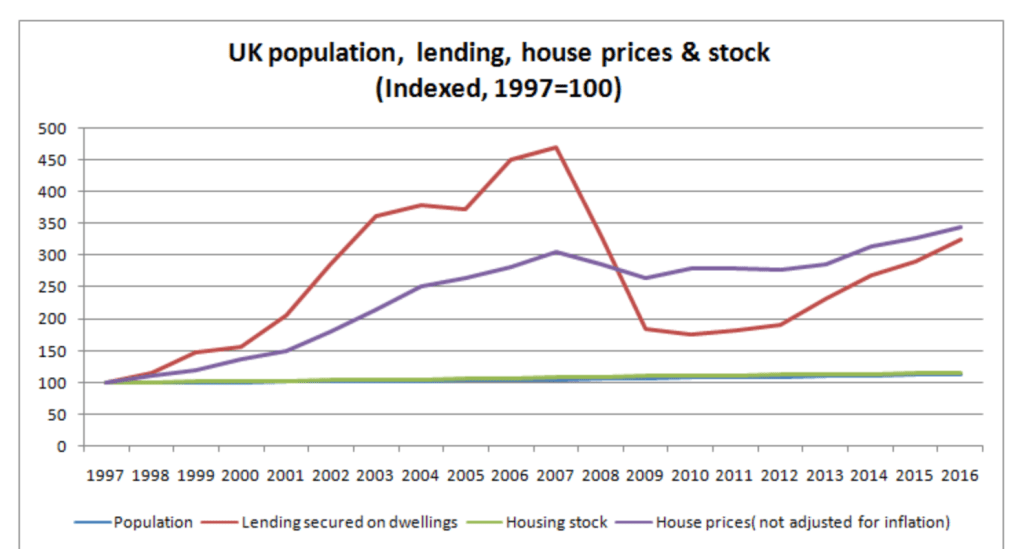
This research was sadly never published (tho referred to in the attached) because by the time it was completed Rogers had reported and Prescot had committed to urban densification and sacrosanct greenbelts). So it was literally suppressed because it was thought ‘critics of government policy might use our results’ – so much for evidence based policy. It was also claimed that our results were absurd and there was no way house prices could rise in real terms by 132% by 2016. In the outturn the increase was around 140% –  depending a bit on what price deflator you use to get ‘real’ price increase. And, as you say Michael, by far the most important driver of this price increase – of course in the face of a supply constraint – was the expected increase in real incomes not population. If you subtracted projected income growth but retained the projected increase in population then the increase was only 4.4%.

Nor do I agree that only a big increase in government house building can generate a serious increase in supply. I disagree because i) all houses, however paid for, need land and that is what we are absolutely constraining; ii) we have completely persuasive evidence that the current set of planning policies are creating a perfect storm in terms of building; iii) if you go back before 1947 to when we did build houses we built lots of them; and, of course iv) there is no way in reality it could happen because of public finances.

In the current GLA area the largest number of houses built since 1945 is some 37,500 in 1970 at the peak of social housing build. Mostly we have averaged around 25,000 a year in the last 60 years but very variable. In fact in 2019/20 we got close to the 1970 figure with not many social houses. But back in the 1930s we were happily building 70,000+ houses a year within what is now the GLA area.  I attach a slide of historic house building in what is now the GLA area.

A minor point on land prices is that indeed they do reflect the expected loss of profits to developers of ‘affordable housing’ production via S106. I searched around for sites with outline planning but no obligations in Barnet and found one implying a price per ha of building land of £37million. At the same time – 2020 – a very senior valuer estimated the price of building land in Barnet at £5m per ha. But of course they were implicitly subtracting the negative value of S106 – so what a developer would pay assuming there would be S106 obligations.

All the best

Paul

Later (7 Dec) change of plan: Paul and I have each submitted 900 words on the government’s and Mayor’s emergency measures. I’ll post them when they are published.

de-bunking build-build-build

blog today 29/11/23 via @explorerDale on Mastodon

Better view of the chart, without the cropping, here:

This picks up on an email I circulated to some colleagues a couple of weeks ago:

Those of you who were at yesterday’s zoom will recall a brief bit at the end when we spoke about the need for better short statements challenging the MUSTBUILDMOREANDMORE orthodoxy in English housing. I said I would make a start and hoped that others would join in. Please do comment or write…. If it takes off we’ll put it on a shared document [29/11 This is now at least visible and open to comments. We can make it a google document if people want.]

I had been triggered by talking with one of our new students who is also a Labour councillor in a London Borough. This is what I just sent him (anonymised)

I am just surfacing after a month dominated by moving house (& downsizing in the process from 6 rooms to 3). I guiltily realised that I never did reply to your request for reading / data suggestions on whether increasing the supply of dwellings, irrespective of price, would bring down the cost of housing in London. Aren’t there better ways of securing affordable housing, you asked? Your officers always insist…

It’s an important issue and the dominant orthodoxy has dominated London, and British, planning for decades. Challenges are mounting up  and I hope that other colleagues will join in giving the best possible answers. I’m going to circulate this to some allies (without your name) and hope we can build up a useful document.

For a start I would read this paper by a whole group of authors including our (Bartlett) Josh Ryan-Collins

Sophus O S E zu Ermgassen, M. P. Drewniok, J. W. Bull, C. M. Corlet Walker, M. Mancini, J. Ryan-Collins and A. Cabrera Serrenho (2022) “A home for all within planetary boundaries: Pathways for meeting England’s housing needs without transgressing national climate and biodiversity goals” Ecological Economics201: 107562 https://bit.ly/3AGgapU

Sections 1 and, especially 2, are a critique of English housing policy and the supply obsession. This is very up-to-date and useful. In my view the best short treatment of the issues.  

(The rest of this fascinating paper is about how the UK’s carbon budget would be gobbled up by anything approaching 300,000 homes a year nationally.)

Also very useful, and even more recent is this paper, not directly on your question but showing how supply-boosting government policies have tended to boost developer profits, not output

Foye, C. and E. Shepherd (2023) Why have the volume housebuilders been so profitable? The power of volume housebuilders and what this tells us about housing supply, the land market and the state, CaCHE, https://housingevidence.ac.uk/publications/why-have-the-volume-housebuilders-been-so-profitable/

Specifically on London, this is the position we (Just Space) took in 2016 and will now have to update for the new London Plan https://justspacelondon.files.wordpress.com/2017/12/js-response-to-housing-strategy-2017.pdf

Then appeared this article from the TCPA (whose journal is at last available online) Murray, C. and P. Phibbs (2023) “Evidence-lite zone: the weak evidence behind the economic case against planning regulation” Town Planning Review 94(6): 597-610

https://www.liverpooluniversitypress.co.uk/doi/10.3828/tpr.2023.24. It’s part of a whole issue which covers ‘resistance’ (to neo-liberalism)

If you have reached this point without finding the space to COMMENT it’s because you are reading this post as the current first item in the blog chain. Please go back to the top and click on the heading. That will put you on the same page as a free-standing object and there you will find the opportunity to COMMENT at the end of the page.

Bob Colenutt writes (1 December)

The Ryan Collins et al article is very powerful.  But I am still not quite clear about the dynamics however, particularly the spatial dynamics and I welcome further discussion. 

Agreed that price movements nationally clearly do not correlate neatly with supply,  and increases in supply do not make a significant impact on house prices.  The article points to overconsumption by those on higher incomes as one factor.  I would suggest that pricing strategies by housebuilders is another. But even so demand and supply relationships are at still at play though in in complex ways.  It seems to me at a local level, and in the second hand market that dominates prices, demand and supply are a factor in house price movements.  

Moreover, regional and  spatial variations in prices suggest that supply and demand are still very important.  The notion of a low demand area correlates with lower prices, and conversely a high demand area correlates with higher prices. This is not due only to spatial differences in wages and incomes but also due to variations in demand.  Housebuilders want to build in high demand areas foremost. 

The shortage of social rented homes is a matter of absolute shortage of these homes. So we don’t want to suggest in our messaging that more of these properties should not be built. Even if the PRS sector is reformed there will be still be a need for a lot more social rented homes, whatever happens to the private housing market.

Although I agree with the argument that more homes will not bring down prices at a national level of analysis, you can’t take demand and supply of houses out of the equation at a local level.  In Oxford we make the case for more housing not because it will bring down prices but because there is an absolute shortage of affordable homes.  It seems to me that the real problem is the lack of affordable homes not the number of homes built or on the market.  

However I do agree that national and local housing targets are pretty meaningless.  They do not equate with meeting housing need in a genuine sense and cannot ever satisfy market demand in booming areas like Oxford.  Nor can they meet demand for socially rented homes. But what I am not clear about from a policy point of view is the alternative.  If we say that the number of new homes is not the issue (in Oxford say) what is the supply side policy?  Are we saying it can found in the under-occupation, inefficiencies and inequalities in existing properties, and how do you tackle that?  Thus supply is an issue but only to found without as much new building. 

There are also issues about the quality of existing housing particularly its energy efficiency which again is not about targets of new supply but investment in current stock. Maybe we need a target for that. .

Anyway just some thoughts

Thank you for pursuing this!

all the best, Bob

Please do add material and/or comment below, or email m.edwards@ucl.ac.uk

Michael Edwards writes: an interim comment on Bob Colenutt, 5 December 2023

Bob I value this comment a lot and knitting it in to the rest of the argument and then boiling it down to short versions will be a good challenge. But my initial comments are:

  1. How can we argue that inadequate supply is not the sole or main cause of unaffordable housing when evidently supply/demand interactions do play some role? The public debates are so polarised that it’s easy to get driven in to over-simplification. The main answers are about time and space, by which I mean…
  2. SPACE: It helps to think of housing markets as whole sets of sub-markets, overlapping and inter-penetrating. The sub-markets are all to some extent potential substitutes for each other, for some buyers. (Flats for bungalows; Witney for Jericho, new for old). Changes in supply in a particular sub-market can have effects on prices in that sub-market which may ripple out to effect others. Developers (big ones) operate multiple ‘outlets’ (selling offices) and adjust their outputs in each to the level they think they will be able to sell annually without having to offer discounts or otherwise drop prices. And of course we know that house prices are determined across the whole stock, in which new construction may be around 1% per annum so, at best, a slow way to try to influence overall prices.
  3. TIME. Those who have tried to estimate how long it would take for increased housing supply in England to bring prices down. zu Ermgassen and others put it well in their §2: “Even if there are housing supply constraints, evidence suggests that expansion of the housing stock may have a limited effect on housing affordability. Estimates of the sensitivity of UK house prices to increases in housing stock consistently show that a 1% increase in housing stock per household delivers a 1–2% reduction in house prices (Auterson, 2014; Oxford Economics, 2016; MHCLG, 2018). This is minimal in the context of a 181% increase in mean English house prices from 2000 to 2020 (£84,620–£253,561; HMLR, 2022).”
    Of course the housing stock is an accumulation of buildings of various ages and many of the events which influence today’s prices for individual homes are long past: infrastructure networks, social infrastructures, designations like green belt and conservation areas. Many of these act over long periods. For example the rapid designation of conservation areas in England since the late 1960s has, de facto, almost frozen the supply of additional dwellings in the areas designated.

References cited in the quote:
Auterson, T., 2014. Forecasting House Prices (Working Paper No. 6). Office for Budget Responsibility.
HMLR, 2022. UK House Price Index – UK Land Registry https://landregistry.data.gov.uk/app/ukhpi/browse 
MHCLG, 2018. Analysis of the Determinants of House Price Changes. Ministry of Housing, Communities & Local Government, London.
Oxford Economics, J., 2016. Forecasting UK House Prices and Home Ownership (Report for the Redfern Review).

Last point, for the moment: nobody (tell me if I missed it) has integrated into the affordability analysis the effect of social class changes since the 1970s: the increase in income inequalities (fastest during Thatcher) wealth inequalities (very rapid more recently and itself both an effect and a cause of house price inflation) and shrinking of the social wage. No ‘market’ could possibly be expected to meet everyone’s housing needs in such a society and we should hypothesise that the housing provision system we have would be good at meeting the preferences of what they judge to be the asset-rich strata of society, and perhaps their children.

If you have reached this point without finding the space to COMMENT it’s because you are reading this post as the current first item in the blog chain. Please go back to the top and click on the heading. That will put you on the same page, but viewed as a free-standing object and there you will find the opportunity to COMMENT at the end of the page. (I think I have understood this.)

Equality & the London Plan

The GLA’s preliminaries to the production of the next London Plan (due to start after the May 2024 Mayor & Assembly elections) is well under way. Ordinary enthusiasts and campaigners are now permitted to apply for the meetings and the outcomes from earlier meetings are being posted on the same page.

I went to a meeting on Friday 24/11/23 about London’s Spatial Structure. A very white meeting and heavily steered. As we found last time (2016) the planners won’t accept anything as structural unless it shows on the map. Thus the severe structural inequalities which became so evident during lockdowns (and which the Mayor’s lockdown research stressed so well) were ruled out of scope. At the table I sat at there were some interesting exchanges about suburban densification, relations with surrounding regions (no longer taboo), opportunity areas. Nothing on overcentralisation or CR2… Our facilitator didn’t know how to deal with one very dull and verbose man, but otherwise OK.
At the end the chair asked what had been forgotten. I said growth /degrowth /growth of what? and raised some cheers.

On Monday I had a ticket for a session on”inclusive design” but now find I can’t go so have written to them about

Equality Impact

The main point I would have wanted to make is as follows. and I hope you can feed it in to the meeting or the write-up.

This meeting seems to be the only place where equality of impact considerations can even be squeezed in.

Your predecessors very correctly enlisted our network, Just Space, to the scoping discussions on Equalities Impact Assessment for the last London Plan but we really failed to reach any agreements. Then when the Draft Plan and its accompanying IIA appeared we were very critical of how it had been done. The Panel deliberated and considered that the GLA should release the detailed analysis which underpinned it. They did so. We found this almost as weak as the original for a whole variety of reasons and, again, persuaded the Panel. 

The panel insisted that the GLA went away and write a serious paper on how each policy would impact on each protected group.

The resulting paper, some weeks later was highly informative, making it clear how in so many respects this plan would be good for richer people and less good, or bad for poor people (and thus many protected groups who share disproportionately in poverty). This was a devastating critique of the plan but the Panel ticked its box for job done and moved on. Had this study been prepared at the proper time —early enough to assist the evolution of the plan— the Plan would have been much fairer.

We are very keen to ensure that this fiasco is not repeated next year. The main aim is to get a better plan which would better serve poorer and minority and disabled Londoners.

A first step would be you discussing this with groups representative of (and run by) the principal protected groups to develop shared understandings of what works for them, drawing also on research evidence. I hope that your efforts last autumn to meet controled and representative samples of Londoners has enabled you to do this, or at least have the necessary database of contacts.

Just Space has not yet put together its positions for the next Plan but we can be sure that these considerations will be to the fore.

Best wishes,  Michael Edwards, Just Space and UCL

Note: I hope we can start pooling these notes on the Just Space web site from people who have attended.

London, Berlin, St Petersburg: 3 gentrifications

Yesterday was a launch event for a book by old friend Matthias Bernt, The Commodification Gap: gentrification and public policy in London, Berlin and St Petersburg, published by Wiley in the IJURR book series.

It’s a great book and I highly recommend it, though the theorisation is not one I subscribe to.  The launch event turned out to be a good discussion with Loretta Lees and me following Matthias’ summary of the book, all chaired by Hyun Ban Shin of LSE. The video recording is at  https://www.facebook.com/LSESEAC/videos/1254068645448989

Order the book direct: https://www.wiley.com/en-gb/The+Commodification+Gap%3A+Gentrification+and+Public+Policy+in+London%2C+Berlin+and+St+Petersburg-p-97811196030

My speaking notes:  
Overall response:  The core of this book is three superb studies which have just the kind of analytical approach which is most valuable in understanding housing processes with a comparative gaze: specifically…

  • Long historical timeline, with periodisation a product of the analysis
  • State/capital relation varies as part of each story, & multi-scale state a key feature
  • Rent & property markets seen as relationships between classes and between individuals, with careful attention to tenures
  • Financialisation always a dimension of the process
  • Very valuable emphasis on degrees and forms of commodification/decommodification and the related political struggles

Learning from each other across national boundaries – great examples in last pages of the book. 

This is just the kind of work I have been attempting to foster among our students since founding a masters programme on property and planning in Europe decades ago. Now I have to re-do some of Friday’s lecture which is wonderful.

What am I worried about? Why am I not the best person to comment on this book?

  1. I never really got comfortable with rent gaps, or the rent gap literature and am amazed by how massive it clearly is. I have been well served by Marx, Harvey, Fine, Haila and co in the analysis of rent and the contradictions generated in private land ownership. Landed property issues are seen as part of class struggle and rent theory is all about conditions which can lead to potential for rent….not deterministic. Very dynamic relationships in which change can reverse the power relations…
  2. I’ve never been much of a user of the notion of ‘gentrification’ despite having been taught by Ruth Glass (and been heavily involved as a DIY culprit, an opponent and a beneficiary of the processes which it comprises). For me it is a helpful descriptive and campaigning term but I don’t think it should be codified in to law or policy or treated as a fundamental concept like accumulation or exploitation.

Where next?

Extend the comparative analysis to more countries and production regimes: e.g. Greece and Turkey very interesting cases where specific regimes of housing development arose (for reasons), flourished, forming social classes in the process, then were superceded (for reasons).

Pay more attention to reversing the commodification through adding controls, tax regimes, conditions. The case material in this book would be invaluable in this and without this sort of analysis policy transfer notoriously fails.

Specifically in England (& Wales) the current collapse of mediaeval leasehold as a tenure form is fascinating. A tremedous shock for marxists and neo-classical writers alike when the state fails to maintain an effective market. Accumulation in the production of flats (so crucial in London) grinding to a halt, and second-hand resales too? State also abdicating responsibility for safety of buildings and some members of our bizarre parliament maintaining that the state should stay out of these matters. 

Levelling up

A year ago, in October 2021, a group of us launched a pamphlet on Levelling Up (a slogan of the UK government) and Planning. Despite some incompetence of mine in managing the zoom, the recording stands up well to the passage of time so here it is. Andy Inch chairing.

Bob Colenutt, Tim Marshall, Michael Edwards, Janice Morphet, Naomi Luhde-Thompson, Levelling Up: the role of planning, 2021. Report download

Risks of Haringey’s #HDV

5 April 2017 I am one of those invited to give evidence at a Scrutiny Committee meeting today, looking into the Council cabinet’s proposals to set up a Haringey Development Vehicle #HDV.  [For background, see my previous post and the Council’s web site.]

evidence from Prof Michael Edwards, UCL Bartlett School of Planning, m.edwards@ucl.ac.uk  [ and later updates at the end ]

My comments are mainly about [some of] the risks and uncertainties which the Council confronts. In this I’m drawing on experience since my first professional job working on the economics of Milton Keynes, through a career of consultancy, research and teaching on the economics of planning and property development. In particular I set up and ran for 15 years a Masters programme on property development and planning, initially with a European scope but now more broadly international. I have also learned a lot from being involved in the King’s Cross development over the last 25 years, and the GLA London Plan process from 2000 onwards. I’m a member of the Highbury expert Group on Housing Supply.

But first I want to make a comment as a resident. I have lived in Seven Sisters Ward for 14 years. I am a regular reader of the Council’s glossy magazine which comes through my letter box and I also get periodic emails from the Council. I have read draft Town and Country Planning documents as they appear and have made representations on some of them. But I have never been aware of, let alone consulted on, the HDV proposal and I think it’s impossible that I would have missed an announcement about it, given my professional interest.

Risks

The Council’s Business Case of 2015 was prepared before the EU referendum and before the numerous changes in housing and planning law which were enacted in the Housing and Planning Act 2016 and trailed in the White Paper recently released. As a result of these changes in the economic and political environment the Council’s decisions have to be tested against a much wider range of possible circumstances than must have seemed likely in 2015.

The economy of the UK is very weak, with low investment; what little growth we have being driven by migration and expanding household debt and no clear prospect that we’ll be able to take advantage of a devalued pound to increase our exports. Many of our export sectors in finance, insurance and related professional services are directly threatened by brexit while others – like the university sector, a huge earner of foreign exchange, are threatened by visa restrictions. We share with Greece the decline in real incomes in the last decade.

We thus need to consider the possibility that the UK economy will fail to grow and may contract in the coming decade. Furthermore the effect of inflation of import prices leading to higher interest rates would both impoverish an indebted population and change balance of power within the HDV.

The other contextual factor is related to housing policy: it keeps changing in ways which make it ever harder for councils to resume house-building. That’s one of the reasons why Haringey has proposed the HDV. But it seems quite possible that government will find ways of extending the Right to Buy to Council-owned companies or in other ways inhibit the efforts of London Boroughs to circumvent government policy. Although the Minister has backed off the RtB threat recently we cannot be very confident.

So what are the risks we should be looking at:

  • The risks of debt exposure of the HDV. We are told that the Investment Partner (IP) will match the value of the Council’s successive transfers of property with injections of equal amounts of its own equity finance. Then on top of that the HDV will borrow the money to do its developments. Can the HDV borrow through the Public Works Loan Board (at about 2% currently) or would it have to pay open market interest rates of perhaps (7-8%)? I’m not a local government finance professional but I doubt whether a private company would be eligible for PWLB.

In any event (whatever the interest rate) if interest rates then rise, it could indefinitely postpone the moment when Haringey begins to receive 50% of the profits from the venture. (We are told that the Council would receive profits only after all debts are repaid.)

  • All the work of managing the HDV and the property portfolio handed over to it on day 1 would be undertaken by the IP (Lend Lease). This would presumably mean that the IP is expected to charge the HDV with its costs, and these costs would undoubtedly include some level of profit to themselves on each task performed. The IP would thus be enjoying steady profits from these operations while the Council would gain no profit share from the HDV until much later, if at all.
  • If the government goes ahead with measures which would impose the Right to Buy on sub-market dwellings produced by Council subsidiaries, the HDV could be losing units which it had made such sacrifices to produce.
  • The Council’s cash flow under the HDV regime would, at least initially, fall because the rental income from its commercial property portfolio would instead flow to the HDV. The leader of the council in her recent article (extract below), implicitly accepts this prospect, but expects it to be made good by growing income from Business Rates and Council Tax. That may be so, but we ought to be able to see the figures.
  • A final risk which I consider should be explored is what happens if and when the IP  decides to sell its share. We are assured by the Council Leader that Haringey would have to consent to any such sale. But if economic conditions become very adverse and there are few willing buyers the Council might not have much choice. I raise this point because we have seen examples, especially in Germany, of large portfolios of rented housing falling into the hands of hedge or private-equity funds of the very aggressive kind which then exert intense pressure to raise rents and evict those who cannot pay. Rather less likely, though possible, is that the Council sells its share, or part of it.

I have listed all these risks because they appear to me to be possibilities which should be explored before the scheme is finalised. Perhaps they have been explored. Your committee and the general public at least need detailed reassurances and surely should be able to scrutinise the cash flow projections which correspond to them.

Alternatives:

Among the alternatives which should be explored I am not at all happy that the set is wide enough or serious enough.

The “do nothing” strategy Option 1 Base Case gets little attention in the Business Case document. But it could really be the best strategy in current conditions insofar as “regeneration” on current models almost invariably leads to a reduction in social rented housing. (Assembly report PDF) It would, in that event, maximise the Council’s capacity to house those in greatest need including the homeless, while not meeting the Opportunity Area targets for total dwelling numbers.

This would combine well with a more piecemeal approach: developing individual sites or estates as an when it can feasibly be done in the changing economic and policy environment. If political condition improve, for example, the Council would be able to borrow and build in the normal way. If conditions get worse, the Council would at least have battened down the hatches.

There is a lesson from King’s Cross here. Camden negotiated one huge outline planning permission for what is now known as King’s Cross Central (KXC) with one huge S106 agreement alongside it. The local community groups called for the Council to give permissions stage by stage but were defeated. Under intense negotiation the scheme was to have about 41% of affordable housing units of various kinds, with some co-funding from the HCA (from the Labour Government). In the first half of the development this went well. But, after HCA funds for affordable housing were severely cut back by coalition and conservative governments, the developer exercised a clever clause in the S106 agreement which enabled them to reduce the social housing % in the later phases. Camden was tied down to a 2006 contract and had to accept a reduction to about 31%.

Had the permission been split into phases, a fresh negotiation would have taken place for the later phases and, since market values for homes had escalated enormously, it would have been possible to negotiate at least the same level of affordable housing, and probably more.

I tell this story not because there’s a likely parallel in Tottenham, but because it illustrates the dangers of committing an entire long-term programme in one agreement.

Finally we should be looking at 2 other alternatives:

A Development Corporation. London has two already and why don’t we explore how good a third one would be for Haringey? Although there is criticism of the level of community engagement in the 2 existing ones, they are at least governed by accountable bodies, with planning meetings open to the public and fully subject to FOI. They also have the attraction of being able to draw on GLA funds.

Finally the study should explore a majority-owned public-private company, perhaps on the model of the Sociétés d’économie mixte in France, hundreds of which have been operating for decades. The law prescribes that public bodies, taken together, must have a minimum of 51% control, and maximum of 85%. It’s a distinctly lower level of privatisation than the 50% proposed here because the public owner can ultimately break a deadlock in the public interest. The economist Nicholas Falk has also written compellingly on German and Dutch models which we should be learning from: [ Main book with the late Sir Peter Hall 2014 on learning from Europe ]
[ 2014 link ] [ 2017 link ]

Extracts from: Cllr Kober article 19 January 2017 http://www.haringey.gov.uk/news/article-council-leader-cllr-claire-kober-haringey-development-vehicle

That transfer of land constitutes the Council’s 50% equity stake in the development.  The private partner then matches that stake with an equal cash equity contribution, cementing the 50/50 nature of the partners’ relationship.  The vehicle will then borrow whatever additional funds it needs to pay for development, and do the building work.  The proceeds from development are then used first to repay the borrowing, and what’s left over is split 50/50 between the partners. [I was told in today’s meeting that this has since been ‘clarified’: the IP’s equity contribution would not be made in one go, all at the outset, as this text implies, but would be advanced as needed, project by project.]

and

First of all, I’m determined that council budgets – and the services which depend on them – are protected.  The first principle has to be that we are no worse off.  Where the council loses rental income from commercial property transferred into the vehicle on day one, we are absolutely clear that the vehicle will make good the difference.  As the vehicle’s work goes on, we will very closely manage both our General Fund and Housing Revenue Account, always ensuring that any impact is manageable.  In the long run, our costs will be greatly outweighed by the returns from development and the increases in council tax and business rate income. 

For further source material see previous blog post.

Later addition, after the meeting.

  1. A courteous committee which asked a lot of questions. It is amazing how little they have been able to find out about the HDV after a year or so of studying it. How can “scrutiny” be applied to something so inscrutable?
  2. I was delighted to hear (informally, in a coffee break) that they had interviewed Pete Redman (of Trade Risks, and the Highbury Group). Apparently, while broadly sympathetic to the Cabinet’s ambitions, he had favoured splitting the one huge project up into smaller ones (one of my main points) and had also made strong criticism of the legality or necessity (I’m not sure which) of the level of secrecy in which the negotiations are shrouded.
  3. They are interested in the continental models and in the experience of other UK Councils.  I told them about Janice Morphet’s work on English LHAs and they might want to meet her.
  4. The other witness this morning was Gail Waldman of the Highgate Society who was extremely knowledgeable about borough affairs and the Local Plan system and policies. She has promised to send me her written submission and I’ll seek her permission to link to it. Very impressive indeed.

Later 12 April 2017 a good blog post by Doug Thorpe of RHN:  http://radicalhousingnetwork.org/a-2bn-gamble-with-public-assets

Haringey “Development Vehicle” #HDV

14 Feb + 19 Feb 2017  The municipality where I live, Haringey, is proposing to pass a large proportion of the landed property it owns (we own) to a 50:50 private company. The plan has been brewing without consultation for some years but surfaced recently through an article in the national press by the great Aditya Chakrabortty and a response by the leader of the council, Claire Kober. I was asked to come to a meeting opposing the sell-off yesterday. A big meeting with 200-300 people: anxious and angry tenants, good analysis, diverse class mix and both Labour and Green parties – perhaps others – as well as non-party people.  My contribution below.

Video of the meeting, notes from Joe Beswick and other material at GreenN8  | Aditya Chakrabortty article | Claire Kober response | Scrutiny Committee report Jan 2017 | Business Case January 2015 | Statement by David Lammy MP 14 Feb | and I’ll add more stuff as it come to hand.

My 5 minutes:

I’m an economist and planner, and now a semi-retired professor at UCL’s Bartlett School of Planning. My comments draw mainly on my experience in supporting community groups negotiating with developers and councils at King’s Cross over 25 years and on the decade of experience across London in the JustSpace.org.uk network of community groups.

One of the big issues Just Space organisations have been battling ever since the GLA was created is the weakness of the Opportunity Areas policies in London – the policies for the main areas where large scale development is planned. There are 38 such areas and rarely any effective participation by residents or businesses in the formulation or execution of plans. These often emerge as cosy deals between developers, compliant borough councils and the Mayor’s office. The outcomes tend to be deeply inadequate provision of social housing, major displacement of low- and middle-income people living in and around the Opportunity Areas and of industrial and service businesses.

The Upper Lea Valley, within which lies most of Tottenham, is one of these and we can see the democratic deficit powerfully displayed in this HDV proposal, smuggled in with no effective consultation. (I’ve been a Haringey resident for many years, receive regular emails and glossy magazines from the council but heard nothing about the HDV until now. Even in the Borough Local Plan documents which I have plodded through I do not believe there is a reference to the HDV.) It seems that Haringey has learned nothing from the famous Supreme Court judgment against it of October 2014 which ruled that consultation is valid only if these conditions are met:

  • Consultation takes place at formative stage
  • Sufficient reasons are given, allowing intelligent consideration
  • Adequate time is allowed for consideration and response
  • Responses are conscientiously taken into account
  • “arguable yet discarded options” are set out with the reasons for the choice of preferred option.

The present proposal is in many ways the opposite of what would be sensible. We are in a period of great uncertainty. Planning and housing law changes frequently, governments in the coming decades might be much more to the left – and thus supportive of Council development— or even more to the right and thus finding ways to frustrate even the optimistic aspirations of the HDV. Interest rates could escalate to more ‘normal’ levels, thus further postponing Haringey council’s expectations of their 50% share of profits remaining after all costs are covered and debt repaid.

In these conditions of uncertainty it is rational, surely, to sacrifice as little as possible, preserving freedom of maneuver for better or even worse times to come.

Community organisations at King’s Cross urged Camden to do its deal with Argent phase by phase but the council refused and signed a single agreement for the whole scheme under the laws and policies obtaining in 2006. After the fall of the Labour government and the withdrawal of government subsidy for social housing, Argent were able to exercise a clause in their agreement to lower their social housing percentage. Prices realised in private market sales of flats in the scheme have of course escalated mightily since 2006 so the developer could well have afforded to maintain their original undertakings from their increased profit. But the contract had been signed in 2006 and could not be re-calculated. Argent argued, quite ‘correctly’, that their responsibility to shareholders, including pension funds, obliged them to do their best for profitability.

The rational course now is for Haringey to put the whole scheme on ice and do a grown-up and open public consultation on a variety of options. The consultation must include cash flow forecasts to deal with suspicions that the HDV proposal has Haringey giving up all its assets at the outset and gains no profit share until after the IP has enjoyed years or decades of profitable operations. The options must include:

A “do nothing” scheme in which businesses can continue to operate and tenant households to remain in situ, their homes remaining in the Housing Revenue Account while leaseholders remain under council freeholds. This is “battening down the hatches” hoping for a more benign policy environment to come. Since “estate regeneration” under current practices leads to a reduction in social housing, this could well be the best strategy for maximising social housing (London Assembly Housing Committee report Feb 2015 Fig 2).

Setting up a wholly-owned development company, as Croydon and now Hounslow have done, or one with a clear majority Council control. A tolerably good model for this is the Société d’économie mixte used all over France in which public bodies must have between 51% and 85% ownership and control.

They should also compare these schemes with a Mayoral Development Corporation. Just Space is very critical of the inadequate democracy embodied in the 2 MDCs established so far (at the Olympic Park and Old Oak Common) but they at least have clear public accountability, prepare local plans which are subject to examination in public and have planning committees open to the public – not to mention access to City Hall funding. So compared with today’s HDV proposal they are much more democratic.

Note: Supreme Court endorsed basic requirements in its Moseley case judgement 29 Oct 2014  http://www.bailii.org/uk/cases/UKSC/2014/56.html  Commentaries at http://www.out-law.com http://www.bdb-law.co.uk ….  R (on the application of Moseley (in substitution of Stirling Deceased)) (AP) (Appellant) 
v
 London Borough of Haringey(Respondent)

Added 19 Feb:  Close reading of the tory government’s recent Housing White Paper by the eagle eyed Joe Halewood points out that the Right to Buy would be extended to all sub-market rental housing (“affordable” as well as social) and to arms length housing companies as well. He wrote on the day the White Paper came out and again today.  He concludes “Hence there is never any chance ever that councils or ALMOs will ever build for social rent and hence all councils will become private landlords.”  Do read it.

There are many examples of this government forgetting to implement some of its more ludicrous or controversial ideas but we should assume the worst. And it reinforces my view —above— that “doing nothing” might be the best course of action for Haringey, or at least it merits careful evaluation against various possible futures.

Joe Beswick writes:  Your point about profits is interesting. A couple of things strike me.

I) a number of the partner offers were a coalition between finance and a housing association, but the council went for LendLease alone.  One of the reasons for this may be because the others were going to give management fees to the housing association, whereas LendLease will contract the council for management – potentially increasing council ‘profits’. The flipside of this is that this, if costly, may in reality put pressure on the HRA, and draw on funds which should be used for the council’s own stock. (This has happened in another borough, whereby these privatised properties are ultimately managed within the HRA.)
ii)  Someone at the meeting mentioned to me that they thought that LendLease are not actually going to contribute their own capital – instead they will just borrow against the properties to make up their contribution. I do not know if this is true, but if so it seems completely outrageous – especially if the costs of that borrowing are paid before profits are divided. And even if not, they would be using (part) public land to secure entirely private loans.
The need to see detailed breakdown of the funding and finances, a cash flow and detailed business plan are clearly massive.   Joe
(M.E. comment:  On both these important points Haringey Council must have the draft contracts or equivalent documents which answer these questions. Without these answers no evaluation of the project is possible, no.)


Next London Plan: the embryo

This post, which will be written over some days or weeks, is my notes as I read A City for All Londoners, published in late October 2016 as the Mayor of London’s first airing of the policies and approaches he has in mind as the basis for the new London Plan, a draft of which is expected in the autumn of 2017. Previous mayors, so far as I recall, have called their equivalents ‘Towards a London Plan’.

What I write here is personal, not the views of Just Space, nor of UCL, nor of the Queen of England. In the back of my mind as I read are the Community-led Plan for London documents which Just Space has been working on for 18 months and in which I have played a small supporting role, mainly on economy.

The first comment I have is on the format. There are no printed copies available, I gather, so everyone must use the PDF. The version the GLA posted was over-designed and terribly unfit for purpose. At first sight it looked like a layout for a 96 page saddle-stitched A5 booklet. But the PDF was compiled so it prints 2-up on landscape A4 and it’s tricky to print so the pages are all the right way up. How many low- and middle-income and/or elderly Londoners have the skill and equipment to print things like this or could pay to get it done on the high street or at the library?city-for-all-spread

Many will want to (or have to) read it on screen, and for that it was deeply unsuitable, mainly because the text is in narrow columns, between 2 and 4 to a page. One has to scroll up and down, left to right to read it: impossibly burdensome, especially on a phone. Nobody seems to have been thinking and I wrote to GLA asking them for a user-friendly version. Meanwhile here is a smaller version which is better for scrolling on devices. city_for_all_londoners_small though the resolution is bad on the maps. Success: within a couple of days Ben Johnson, the mayor’s advisor on Digital matters replied to say that the team had replaced the bad PDF with a better one.  The new one scrolls in the same simple way as our version and his high resolution images (though the page numbers no longer correspond). Congratulations to them for listening.  And they say they are giving thought to improving the accessibility of documents in future, especially consultation documents.

My wry friend Robin, when we first looked at it, came to a page with a map and said “Oh look, no photo of the mayor.” He was spot on: this plan has something like 20 photos of the mayor. That must a world class achievement. A professor I know carefully deleted all these pictures of the mayor to conserve his ink cartridges: it’s not just the poor who economise.

The mayor’s foreword is warm and personal, emphasising his fear that young Londoners today are being deprived of the opportunities he had. The strains of growth are referred to, but the growth itself is unquestioned.

The summary and structure are simple and make clear the thrust. First comes Accommodating Growth. No questioning the desirability or the character of growth, or the ambition to fit as much as possible of it within London – a slight shift from previous mayors who pretended it could all be fitted in. Housing is, as usual, treated just as a supply problem (not enough have been built, and so on) without any reference to how demand got so out of hand, so inflated, so unequal. Nothing about the haemorrhaging of the social housing stock and no attempt to qualify his use of the word ‘affordable’. No mention at all of private renting or of cuts and caps to benefits. Depressing. The economy paragraph does at least refer to brexit but it sees success as though economics were an olympic sport where London is defending its gold medal: making London as attractive as possible to the imagined global players, calling for an immigration system fostering access to talent and so on. There is a slightly surprising new (to me) strand of idiocy: that we need to protect our environment and our world class culture so that people and businesses around the world… A sentence about ensuring that everyone benefits and finally “I will also promote economic activity across London, day and night, and take account of the particular needs of small businesses operating in the capital.” We have clearly had no impact whatever: ‘across London’ reads to me like softening-up the reader for a throughly centralising plan in which suburban employment will continue to shrivel. And note that small businesses just have ‘needs’, no potentialities.

A portmanteau paragraph called environment, transport and public space then says nothing tangible though it does set a target for London to become zero-carbon by 2050. I must check whether that is significant, and whether it includes aviation. Nothing on reducing the need to travel. The final section of the summary returns to the overall title: a city for all Londoners and to me it seems excellent and relatively  heartfelt. I just quote (most of) it: ‘For the city to be successful, Londoners in all their diversity must live well together. Social integration is a broad but vital concept – it means addressing inequalities, tackling disadvantage and discrimination and promoting full participation in the life of our city. It means considering how people from BAME, disabled, or LGBT+ communities, as well as women and young people from low-income families, are disproportionately affected by all issues in London – and making sure that in every area of policy, they are given the resources they need to make London a more equal city. Social integration relies on an affordable, accessible transport system, measures to improve health and reduce health inequality, and ensuring that the city’s amazing culture continues to thrive and unite us.…’

Nothing in this summary about democratic process except that that final paragraph on inequalities does have ‘…promoting full participation in the life of our city.’ [I’ll reflect and add more comments on that later. There are contradictory signs about City Hall’s attitudes to public participation this time round.]

There remains the unspoken issue of scope. The London Plan should deal comprehensively with the city but has always been blinkered by the fact that it has significance under the Town and Country Planning acts as part of the Development Plan and this has perhaps been a reason or a pretext for limiting it to land use and related transport issues, even though it is supposed to be embody the spatial integration of all the mayor’s strategies.  (Check that wording).  Thus the plan has nothing about the fiscal constraints on GLA activity or about the appalling and vindictive cuts which have been imposed by the Tories in national government on Labour Boroughs. It has nothing about health services despite the under-funding, privatisation and re-structuring being inflicted on them, nor about education or social security. The City Hall defence would be that health, social security and education are not competences of the GLA but that should not prevent their treatment in the analysis and the plan as essential to understanding the social and economic dynamics of the city (not to mention some severe coordination failures which flow from their omission).

Digression: the launch event
Some of us got seats (or just smuggled ourselves in) to the launch event this morning 31 October. There is quite a lot on Twitter #allLondoners, much of it from @Justspace7 but some from other people. A very middle-aged and mainly white crowd in the room.
The GLA fielded a powerful panel: John Lett + deputy mayors + Benson from Housing and others. The overall impact on me was that this is a slightly more encouraging apple pie than the apple pies of previous mayors but that everything depends on the detail of exactly how it is elaborated and implemented. All of the ideas and proposals, I think, were evident in officers’ discourse before the mayoral election, and many were embodied in the very undemocratic 2014 document London Infrastructure Plan 2050. If the new mayor has any hand in the new document it is a matter of emphasis: some modest proposals for private rentals and an aspiration for 50% affordable housing (though with much of it not in fact affordable to most Londoners). Pat Turnbull of London Tenants Federation and Just Space made the most powerful intervention from the floor, asking where were London’s working classes who had to make the greatest sacrifices —loss of their estates, displacement, seizure of their estate green space— to enable housing to be built which they could never afford to occupy. Applause.  Richard Lee asked for audio and transcripts to be placed on the web site & was told that there would be written records of the workshops and launch (though probably not transcripts) but that audio would be given consideration…). Strong sense that ‘consultation’ is mainly by invitation. Delighted that the slides shown at the launch were made available the same day. I did, after the meeting,  extract from Ben Johnson (advisor on business and digital policy) an undertaking to try and get a user-friendly PDF.  End of digression.

Now to start reading the main sections…

Accommodating Growth

Starts by outlining population and household growth and the (unquestioned) need to accommodate it. There is a sentence in the first paragraph on the incursions that makes on the rest of the city’s land: “…As well as housing, it is also crucial to sustain and promote economic growth by making the right decisions about places of work. Land is in high demand for many other competing priorities, such as green space and infrastructure of all kinds.…” but still it is couched in terms of growth.  It’s good to see it there but the devil is in the detail.

The discussion of land and floorspace for employment (I’d prefer to call it non-residential activity so it’s clear that it covers education, health, libraries and so on – but that sounds pompous) starts with central London —the Central Activities Zone CAZ— where the mayor plans to resist change of use from office to residential “…unless this can be justified…” and facilitate inward commuting.

In the rest of London the mayor  says “Across the city, I will make provision for industrial and retail activity, and I will promote viable strategic locations for office space, including in Outer London.” This paragraph goes on with the assumption that fostering “regeneration” is an aim.  A few comments on all this:

The text is trapped by some dead or dangerous categories: “office”, “retail”, “industrial” and “strategic”. First of all the range of activities which goes on is now really hard to force into the categories of land use classes. Vehicle repair takes place in all manner of premises; delivery/distribution of goods involves huge purpose-built sheds through smaller industrial estate buildings, retail ‘parks’ to tiny depôts, pickups and drop-boxes  in shops, stations, petrol stations and so on. While the vehicle movements associated with all this distribution activity do seem to be alarming TfL, there is no sign that the premises dimension is getting any attention, nor that the pollution and congestion aspects are being examined. There is more to the economy and society than the property investors’ and planners’ categories of office, industrial and retail.  The best passage in this text is the bit on cultural activities (“cultural capital’) where the full range of locations is reviewed. But the same could and should be done for the rest of the economy and that’s what’s missing. No sign here of the JustSpace discussions with GLA Economics about what they should be doing in their Evidence Base. 

One of the fallacies embedded in London planning is that only very big things can be regarded as ‘strategic‘ and thus merit the GLA’s attention and policy: big industrial areas, big shopping centres. In fact major changes in the structure of London are the cumulative outcome of thousands of small changes, extinguishing services and jobs in high streets and behind them.  This is what has led JustSpace to call for careful studies of these local economies.

We really do have to push for the GLA to start from the economy we have, paying as much attention to the non-sexy 50% of jobs outside the main centres and high-value sectors. They don’t seem to realise that the extinction of that activity makes a negative contribution to growth while improvements in pay, productivity and output there is just as much a contribution to growth as more jobs in finance and business services.

This chapter on conflicting demands for land breaks out inexplicably into a section on transport. It says “To manage this demand, I will look at introducing innovative methods, including using road space for different purposes at different times of the day, shifting lorry consolidation centres closer to the River Thames or the rail network, and encouraging more business deliveries by bike.” This all sounds decent, though the shifting of “lorry consolidation centres…” sounds half-baked, or perhaps a poor summary. perhaps it mean break-of-bulk rather than consolidation. Rail and river (and canals) are indeed good ways of bringing in heavy and bulky stuff, saving very large amounts of truck traffic. So thats good to see, but it means protecting wharves beside the water and keeping some railway sidings free of housing developments and that’s what we have to watch out for in the Plan, when it comes. Still nothing about reducing the need to travel by bringing homes and destinations closer to each other, fostering local services or realising the concept of ‘lifetime neighbourhoods’.  [That was the only good idea to enter London Planning in the Johnson period and has now disappeared from the text.]
Rebalancing the UK economy and the role of citizens’ organisations

The downsides of London’s widely heralded role as the ‘engine’ of the British economy are largely borne by citizens, but there may be signs of change in the way that community groups in the capital have begun to make themselves heard – offering experience from which all in the wider metropolitan region could learn, says Michael Edwards

[Contribution to a special issue on Planning in the London Metropolitan Region of the journal Town and Country Planning, guest-edited by Duncan Bowie. The whole issue is available from the TCPA here. ]

We have lived through the first two mayoralties of the Greater London Authority (GLA), governed by the imperative that the scale and nature of London’s growth cannot be questioned and by the fantasy that the space requirements of this growth can be met within the Greater London boundary and without attrition of the Metropolitan Green Belt.

The growth imperative remains widely unchallenged, but the palpable impossibility of the containment fantasy now seems to be accepted by professionals and by many of those in power. Housing market demand knows no bounds and spills ever further into surrounding English counties, spreading the affordability crisis far and wide. London local housing authorities, desperate to meet their homelessness and other obligations, are increasingly placing their tenants wherever they can find space cheaper than the private rented stock of London.

Within Greater London there has been a severe democratic deficit as financial, infrastructure and real-estate interests have been able to set the agenda for the planning of the city, reaping rents, capital value growth and profits from the concentration of building and civil engineering work in the capital. The conventional measures of GDP and GVA show London as a ‘success’ and feed the narrative that the city is the ‘engine’ of the British economy – this despite the omission of environmental costs from those measures, the fragility of the rentier economy being produced, and the somewhat illusory character of the growth component which comprises rents and the imputed rents from the growth of value of the owner-occupied housing stock.

The downside of London’s fabled agglomeration economies is largely borne by citizens in the form of high rents and prices for housing, high travel costs, air quality which seriously breaches the law, displacement and disruption of communities and enterprises and the dispossession of tenants and leaseholders in erstwhile social housing. It was no surprise when the Resolution Foundation analysed median household incomes in UK regions since 2007-08 and found that London is superficially a rich region with a strong post-crash recovery but that, after paying housing costs, Londoners were by no means the richest and had seen the worst real income falls in the entire UK.1

The forms of democracy we inherited have not enabled these oppressions to be voiced effectively in policy-making. But there are signs of change as the victims of Britain’s uniquely dysfunctional housing system get organised (Priced Out, Generation Rent, Renters’ Rights London, London Tenants Federation, Radical Housing Network) and broader campaigns emerge (Take Back the City, Reclaim London). On specifically planning issues, Just Space has grown to be a strong network of local and London-wide citizen organisations, supporting each other (in the absence of any public funding) to make effective use of the participation opportunities which planning, environmental and local government law provides. It has just published its proposals for the next London Plan to the new Mayor and Assembly: a big achievement for a city of 8 or 9 million Towards a community-led plan for London: policy directions and proposals. It works in effective co-operation with the long-established London Forum of Civic and Amenity Societies, finding much common ground despite a different class composition and working method.2

It has been hard enough to scale up community activism in London from its long-established neighbourhood scale to span Greater London. How might it extend even more widely in the coming years? In some ways the imperative is for citizen organisations in all the UK’s regions and countries to co-operate since —as in so many European countries— it is the widening disparities at the national scale that need to be challenged and changed. The multi-scale structure of the Social Forum movement of the early 2000s would have been an ideal framework for these grass-roots collaborations, but that whole system seems to have wilted, at least in the UK. In the world of political parties, perhaps the rejuvenated Labour Party might become helpful, as is the Green Party to some extent. The New Economics Foundation (NEF), IPPR North and the Centre for Local Economic Strategies (CLES) are valuable beacons of sanity and analysis, but none of them is more than an infrastructure for social movements.

As things stand in 2016 it appears that we shall be getting officer-level and member-level collaborations between the London and nearby local authorities. Representative democracy in these Home Counties is weakened by the first past the post electoral system and, as a Londoner, I would guess that working class and low-/middle-income communities there feel even less empowered than their London counterparts. At least in London there is an element of proportional representation in the London Assembly which has made that body, while still toothless, a remarkably effective sounding board and debating site compared with most local councils. We shall see.

On the other hand, some of the geographical wheeling and dealing is likely to be done by Local Enterprise Partnerships (LEPs), even more removed from grass-roots accountability than local councils. Some older readers will remember, however, that the abolition of the Greater London Council in 1986 was followed by 16 years of similar informal consultations among London boroughs in LPAC (the London Planning Advisory Committee). That system was widely expected to be an ineffectual talking shop, but it surprised everyone by building some strong consensus positions, often quite progressive, and leaning on national governments. It was democratically accountable only in the most indirect sense and scarcely engaged directly with citizens, but it did have some achievements. Could today’s informal local authority collaboration develop the strength needed to enforce planned new urbanisation on reluctant shires?

A rebalancing between UK regions would take time, and presupposes a release from the damaging orthodoxies of neo-liberalism. However, the potential for multi-scale planning of regional development in Southern England is immense, the need for it is urgent, and progress could perhaps be made. The experience of community groups in London suggests that planning should be guided by the following principles:

  • reducing the need to travel (and for road freight movement), especially by private vehicles – and doubly so for diesel vehicles;
  • meeting the backlog of unmet housing need and keeping up with the growth of need and demand, providing for more refugees and migrants; and
  • respecting environmental limits, slowing climate change (while preparing for it to accelerate), and making the most of highly valued urban and rural landscapes.

Progress on these fronts will be a major challenge. The vested interests in high and rising house prices and rents (the financial sector, landowners, and many owner-occupiers and professions) are powerful. Infrastructure builders and investors are interested in heavy radial railways to permit London’s housing deficits to be met by dormitory settlements along the lines – rather than in the less glamorous job of reducing the transport damage caused by daily life in our spaced-out polycentric city region. Thinking in London’s City Hall seems to favour shifting employment growth out to the Home Counties on the grounds that this would be politically easier than shifting housing growth out. That might be expedient, but it does not sound like a reduction of the need to travel, and it threatens to exacerbate the crisis in workspace availability within London, driven by inflated housing land prices and the dismantling of controls which have kept land use classes as separate property markets for 70 years.

We shall be regaled with pleas for a more polycentric system of settlements within and beyond London, and the heroic ‘Polynet’ research of Peter Hall and Kathy Pain will be cited in support. But their analysis drew attention to the environmentally alarming scale of travel – especially car travel – generated by our dispersed settlement system. Growth of employment and housing across the wider region will have to be very systematically modelled and managed if it is to strengthen local economies without growth of car dependence. An opportunistic splatter of new towns, new villages, urban extensions and transit-oriented developments could be the worst of worlds.

Furthermore, within London, powerful market forces driven by a financialised housing price boom have combined with de facto planning practices to create an increasingly centralised structure of employment growth, eating away at diverse local service and manufacturing economies. London’s greatest 21st century achievement of reversing the growth of car-dependence will be very hard to roll out across the wider regions, and the ambition of current policy debates does not seem adequate. It is hard to be optimistic just now.

Michael Edwards is a Teaching Fellow at the Bartlett School of Planning, University College London and a co-organiser of the Just Space network. The views expressed are personal.

Notes

1 A. Corlett, D. Finch and M. Whittaker: Living Standards 2016: The Experiences of Low to Middle Income Households in Downturn and Recovery. Resolution Foundation, Feb. 2016. www.resolutionfoundation.org/wp-content/uploads/2016/02/Audit-2016.pdf

2 This article draws with gratitude on the author’s very stimulating years of work with the Just Space network of London community, activist and ‘voluntary’ organisations seeking to influence planning within the GLA boundary. It is in no way written on behalf of Just Space, indeed some of the issues raised here have not yet been discussed within the network. Thanks to the TCPA for triggering these reflections, which may thus enter the network’s debates. [later note: some of the issues raised here are discussed in the Just Space Economy and Planning Group’s Commentary on the Draft Economic Evidence Base for London Planning prepared by GLA Economics. ]