Euston Square again

This appeared today in Bluesky

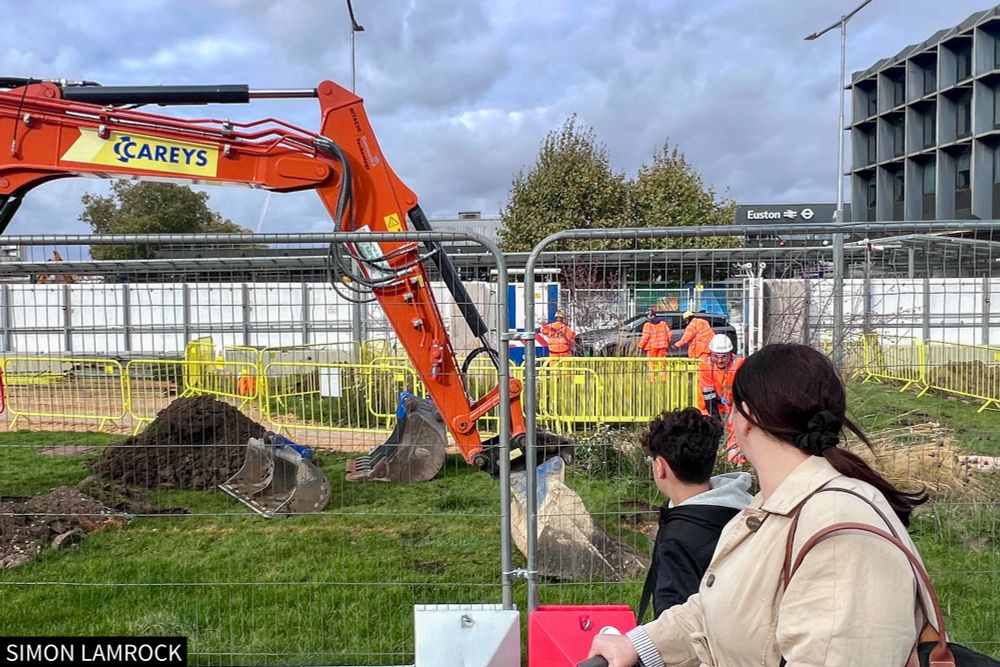
HS2 works to remove remaining plants and trees at Euston Square Gardens begins — another green space lost forever

[image or embed]— Simon Lamrock (@simonlamrock.bsky.social) October 28, 2025 at 1:00 PM

sequel to the #EustonPuddle saga of 2010-12 QV

I had posted Both those Euston towers gone; trees felled by #HS2, grass turned to concrete by #HS2 for taxi rank, used briefly. The quakers destroyed the southern half of the Square about 1920, #HS2 the rest now. Photo by me.

and Simon had replied:

Euston Square Gardens South was a 1920’s land grab — 100 yrs later much the same is happening again.

Writing in 1923 to the Times university constituency MP Sir Sydney Russell-Wells stated

“once built on, it goes without saying that the land is lost forever”

First day of term

Did my annual lecture to the new students of UCL’s Development Planning Unit (#DPU) yesterday. The day was quite wearing and I was tired when we began at 1700h but, as usual, the necessary adrenalin appeared from somewhere and I talked for an hour, followed by questions and discussion for another hour which I much enjoyed. These students come from most of the world and are in many cases quite experienced so the range and depth of questions is all good and stimulating. A repeat coming up today for Bartlett Planning students but on zoom, so harder to do.

Typically we had some good exchanges on ‘which countries get it right?’ about housing. I spoke about Germany and about Switzerland’s coops (and was going to say about Vienna and Finland but we got diverted). I said that on this subject the discussion often ends with someone saying Singapore is the best model. A woman in the theatre shouted ‘NO, I live there and it’s absolutely not’, to cheers and laughter.

Jason Katz came along and told me he made a recording. He was a help with some of the questions, partly because my hearing fails on questions from the back of a big auditorium. We should have used a roving mic. He’s probably hoping we can publish a text. We’ll see.

Then I went home and had dinner with Sue and flopped, not able even to focus on the TV. I idly picked up the latest LRB and in amongst the reams of scholarship I don’t want or need is a wonderful long review by Adam Thirlwell of a new book on Gertrude Stein, one of my great heroines (¿heroes).

I woke up and was gripped, still awake when I finished it at 2300h, long after I would normally have gone to bed, or at least to sleep. Nobody uses language as Stein does and this reviewer – and clearly the book’s author Francesca Wade – share fully in the delights and puzzles. Birthday reading I think if there’s a Kindle. [Next day I am reading the review again, slowly, and reach this point: ‘And they can’t be read quickly; they seem to require deep leisure time before and after, just as they were written, almost as if you have to be in Paris or the South of France, with many parties ahead of you, to be able to enjoy them.’]

[Later 31 Oct: Sue got me the book for my birthday and I am reading it with glee.]

One of my favourite phrases is ‘I like a view but I like to sit with my back turned to it.’

I put out a post on Bluesky asking people what I should recommend for new students to read to get the hang of England and keep up: newspapers and so on. ‘FT (free to our students), ByLine, Londonist, LondonCentric; warnings on Guardian and OnLondon.’ Suggestions welcome. Max Nathan adds @londonermag.bsky.social

Then on Wednesday I did the repeat talk to some hundreds of Planning School new entrants, on zoom. I felt it went badly. Big gatherings are much better live, in my experience. My cold had me coughing a lot which didn’t help and some interesting interruptions slowed things down. I didn’t get to the end properly but stopped after a long hour, fearing people would get restive. But the questions (via CHAT) were very good ending with ‘You have stressed the negative features of London Planning. Is there nothing positive to be said?’ After a rather long pause I spoke about the air quality improvements and how both CC and ULEZ needed strong mayoral support to go through. And I described the public transport system as really brilliant, for all its faults. But I should also have spoken about the huge achievement of the Livingstone period in reversing the trend of modal split and the threats to it now from the reduction of bus lanes. I’ll mention that to them when. I see them again on Friday on our Thames boat trip.

An unlikely alliance?

17 September and later.
Today I had an argument with Paul Finch which made me think of writing this open letter to him. Labour and Tory parties in Britain have converged on housing and planning policies which most of us completely reject and I’m detecting some common ground between what deregulationists like Paul Finch and leftists like me are saying. Odd but true. Here goes.

This exchange continues in An unlikely alliance 2 (to come)

Dear Paul

At the end of Tuesday’s meeting of the London Planning and Development Forum you made an impassioned speech which roused the meeting to clapping and cheers.

I agreed with half of what you said but not the other half. The common ground seems to be worth exploring.

The essence of your argument was that the UK saw its biggest housing output in the postwar years when public sector and private sector were both producing. We won’t get such massive output now without the state again building at a large scale. (Agreed)

Private housebuilding firms won’t supply social housing / ‘affordable’ housing at the required scale where the costs come on top of general inflation of building costs plus rising environmental, floorspace, safety and other standards, especially in a shrinking economy where disposal prices in the private housing market are flat-lining or falling. (Agreed)

It’s wrong to blame the planning system for this failure to build a lot more. Planning authorities don’t (on the whole) build. It’s private housebuilders who decide how much to build. (Agreed)

Housebuilders are like bakers making bread. If they are told to give away half their loaves at half price they will naturally shut down production. (Disagree)

I disagree with this step in the argument because the costs faced by housebuilders include land whose behaviour is special, accounting for a third or a half of the final price of a house. Over recent decades the prices of residential land in the UK, especially in and around London, have escalated very dramatically as developers have made large bids for sites in the good years and builders can’t/won’t meet all the demands for affordable homes, better standards, payments for infrastructure, especially in a falling market unless they can get land much more cheaply. Land prices ‘ought’ to fall in these conditions and Mr X, the strategic land expert who spoke to us today, confirmed that development land prices can and do fall. But evidently — for our discussion — not fast enough, and that will be especially so in London. Housebuilders are stuck with the sites they own and what they paid for them. I think the evidence supports my version of this problem. We would need to get land price expectations down, as Prof Ian Gordon said today, to have any hope of bringing house prices down to more affordable levels. Until then, land prices ratchet up more readily than they fall.

The important disagreements in all this are about why land prices and house prices have risen so much. Labour and Tory leaderships have swallowed the argument that it’s just down to an inadequate total supply of homes. There are crude and more sophisticated versions of this position but many of us disagree. House prices have been driven up by the combined action of many forces:

…Paul Cheshire’s analysis showing that as people get richer they consume more housing, for a whole variety of reasons (expand)

…Combined with sustained income growth for better-off UK households in our increasingly unequal society

…Combined with the lavish availability of mortgages since the 1980s to cover our lavish bids for the next home as we trade up, and more recently for buy-to-rent

…Combined with the tax/subsidy treatment of owner-occupation and housing generally, including IHT, CGT and the way housing benefit (LHA) has sustained the growth of private renting and the way Help to Buy fuelled prices and builder profits.

…Increasingly by the feedback loop in which old people like me, enriched by these mechanisms over a working life, pass this crazy wealth on to our children by gift or bequest, further accelerating price growth.

…But this is not the whole story. Housing markets are partly local and prices reflect access to jobs, environmental qualities, state investment in Elizabeth Lines, super-sewers, good schools and so on. London and its region are uniquely well-endowed in these ways, not to mention with theatres, concerts, museums and universities which people want to use.

The crude versions of the supply-side argument simply propose massive de-regulation, assuming that housing output would grow without social housing obligations, conservation areas, green belts, biodiversity net gain and so on. Many of us are unconvinced and the serious research on the subject suggests that the affordability benefits would be very very slow indeed, swamped by all these other factors pushing prices up, and environmentally disastrous too..

The Mayor of London is clearly not keen on us discussing these issues. The planning team wants to be left alone to produce what looks like being an even worse plan than its predecessors.

How can we progress it?

Perhaps a version with footnotes should be next.

Michael Edwards

A few days later Paul Cheshire sent this reply:

Nice letter but I fear I disagree with your arguments in crucial places.

First and most important is the work I and others at LSE (particularly Christian Hilber) have done now over many years (you were involved as an ESRC overseer/interlocutor in the first project back in the early 1980s). In my judgement this line of research has produced overwhelming and absolutely rigorous evidence that the planning system we have in Britain is the major cause of our housing crisis – a crisis or supply. The co-authored paper Christian published in the Economic Journal in 2016 (The Economic Journal, 126, 358–405. Doi: 10.1111/ecoj.12213) demonstrated that variations across LAs in their ‘restrictiveness’ – measured as % of major applications rejected, offsetting in an econometrically very sophisticated way for problems of reverse causation or endogeneity – causally explained a variation of at least 25% in the difference in house prices – all other characteristics held constant – between the South East and the North. This still excluded the constraining effects on supply of both Green Belts and Brown field first policies and the uncertainty the discretional decision making process of our planning system (not Continental European systems) injects into the development process. The uncertainty generated by our locally politically controlled and lobbyable planning system in turn helps drive the monopolisation of our development industry because it generates a big barrier to entry favouring bigger firms.

The brown field and greenbelt policies – in place respectively for a generation and over two generations – constricts land supply for housing and most strongly constricts it in those places people most want to live – near big urban jobs markets. The most convincing evidence for me on the effects of this constriction of land supply was the modelling Steve Sheppard and I did back in the late 1990s early 2000s, commissioned in April 1997 (when there was no government),  by the then DETR to model the impact on real house price growth between 1996 and 2016 of alternative policies for land release. The results of this modelling (again very detailed econometric work using observations of actual houses, the size and shape of their gardens,  transactions in them and the characteristics of the households who bought them including their incomes) concluded that the combination of both these restrictions on land supply for housing would lead to an increase of 132% in the real price of characteristic-constant houses by 2016; and that was when the brown field target was set at only 60%.

This research was sadly never published (tho referred to in the attached) because by the time it was completed Rogers had reported and Prescot had committed to urban densification and sacrosanct greenbelts). So it was literally suppressed because it was thought ‘critics of government policy might use our results’ – so much for evidence based policy. It was also claimed that our results were absurd and there was no way house prices could rise in real terms by 132% by 2016. In the outturn the increase was around 140% –  depending a bit on what price deflator you use to get ‘real’ price increase. And, as you say Michael, by far the most important driver of this price increase – of course in the face of a supply constraint – was the expected increase in real incomes not population. If you subtracted projected income growth but retained the projected increase in population then the increase was only 4.4%.

Nor do I agree that only a big increase in government house building can generate a serious increase in supply. I disagree because i) all houses, however paid for, need land and that is what we are absolutely constraining; ii) we have completely persuasive evidence that the current set of planning policies are creating a perfect storm in terms of building; iii) if you go back before 1947 to when we did build houses we built lots of them; and, of course iv) there is no way in reality it could happen because of public finances.

In the current GLA area the largest number of houses built since 1945 is some 37,500 in 1970 at the peak of social housing build. Mostly we have averaged around 25,000 a year in the last 60 years but very variable. In fact in 2019/20 we got close to the 1970 figure with not many social houses. But back in the 1930s we were happily building 70,000+ houses a year within what is now the GLA area.  I attach a slide of historic house building in what is now the GLA area.

A minor point on land prices is that indeed they do reflect the expected loss of profits to developers of ‘affordable housing’ production via S106. I searched around for sites with outline planning but no obligations in Barnet and found one implying a price per ha of building land of £37million. At the same time – 2020 – a very senior valuer estimated the price of building land in Barnet at £5m per ha. But of course they were implicitly subtracting the negative value of S106 – so what a developer would pay assuming there would be S106 obligations.

All the best

Paul

Later (7 Dec) change of plan: Paul and I have each submitted 900 words on the government’s and Mayor’s emergency measures. I’ll post them when they are published.

London Plan (Towards…)

16 September 2025 Ian Gordon has published a blog post about all this, reviewing 6 submissions. A good read. https://blogs.lse.ac.uk/lselondon/towards-an-effective-london-plan/

22 June (closing day for responses to the GLA document Towards a New London Plan). This is my personal submission. Ill health has greatly reduced my capacity and all I have been able to manage is a response to part 1 of the survey. I tried to pack in all my main concerns. (Much has also fed in to the Just Space submission which Michael Ball is finalising right now.)

It is still not too late for anyone to make their own submission – to all or part of the Towards… document. All the links you need to read it and reply are at JustSpace.org.uk/towards

1.  Paragraph 1.1: What is the London Plan?

GLA often argues that LP can only deal with town and country planning matters. That’s arguable. But this Towards… document is not constrained in this way and should have ranged across all the linked proceses: economy, housing, environment and so on.
Its scope is utterly unfit for the multiple crises we confront.

3.  Paragraph 1.3: How many homes will it plan for?

Towards… is based on the same completely mistaken interpretation of the crises which we all agree the city confronts; the belief that the affordability problems would be solved by dramatic increases in supply. This myth has been roundly debunked as a national strategy and, for London, successive London Plans have attempted to apply the remedy of maximising total output. Not only has this failed to slow the growth of rents or prices but it has led to a growing unmet backlog of need for low-rent council homes and caused great damage to other aspects of the city: diverting employment land, eroding greenspace, overloading social infrastructure and – now – threatening green belt as well. It has also eroded the stock of council homes through the estate regeneration process and permitted other disposals. Not only does Towards… fail to recognise this massive failure, but it proposes to make matters worse by chasing the impossible output target set by an equally misguided national government.

4. Paragraph 1.4: Viability and delivery

The coalition government’s decision to make ‘viability’ the make-or-break criterion for development decisions has been a disaster. While outside the GLA’s control, much more could have been done to minimise its impact, especially its impact on land values and on S106 negotiations.
New approaches are now essential: to lobby government more effectively on Right to Buy, on rent controls, on AHP budgets; to adopt policies aimed at moderating land price growth and to force land prices down to the levels at which council-level rental housing proportions can be accommodated.

5. Paragraph 1.5: What is this document about?

The Towards… document is profoundly inadequate. Ill health is preventing me from responding to later sections of this survey which I would normally want to do.

6.Paragraph 1.6: Legal and procedural requirements

I am profoundly dissatisfied with the conduct of the London Plan team since work ended on the 2021 Plan.

You should have analysed the effects of the radical policy changes embodied in the 2021 Plan. The density matrix was criticised for not being enforced. Instead of enforcing it, and thus probably damped land values, the GLA insisted on scrapping it, relying instead on boroughs to use ‘design considerations’ to develop density policies and (related) tall buildings policies. What effect has this had on densities and land prices? Other novel policies in the 2021 plan should also have been evaluated. No such analyses are visible.

A second key activity for the LP team should have been to evaluate the possible futures for London opened up by climate change and by the mounting inequalities of income and wealth generated by the London economy and housing system. The pandemic made some of these processes very visible and dramatised the inequalities experienced by Londoners, especially those in low paid and insecure jobs, in transport, retailing and distribution and those from certain ethnic groups.

A further set of futures needing exploration are the consequences flowing from Brexit.
Instead of informing London through this kind of research and fostering a better-informed and engaged population, the LP team seems to have been keeping us at arm’s length while they have conducted a one-way harvesting of opinions and experiences through the Planning for London programme. They are behaving like control freaks.

7. Paragraph 1.7: Integrated Impact Assessment (IIA)

I and Just Space and others were very critical of the GLA last time around for the many inadequacies of the Equalities Impact assessment. The Panel of Inspectors in 2019 insisted repeatedly on the GLA doing more work on this topic – which revealed in the end how regressive were many or most of the Plan’s policies. We had argued that the London Plans were dominated by property and investor interests and this tardy and reluctant analysis proved us substantially right. But nothing could be done then to deal with the criticism that the equality studies should have started at the beginning of the planning process and it bodes very badly for this new plan that the long-promised consultation on the draft IIA scoping report will begin ‘later in the year’.
The same issue arises with the SEA which should already be evaluating alternative strategies for London.

10. Paragraph 1.10: Good growth objectives

The mayor clearly feels the need to trumpet growth out of respect for the new national government leadership, and perhaps as a means of levering funds to support the ‘engine of the nation’. But his London Growth Plan is just a marketing document which appears to be written by estate agents and contains no serious analysis.

Seriously, though:
Towards… does not confront the fact that London’s economy is a machine which sucks in investment in transport and other infrastructure, pumping up central area commercial property values and city-wide house prices and rents. Thus landlords, owner-occupiers and property interests benefit from massive asset value growth while renters have seen their real incomes (after meeting housing costs) static or shrinking. This is not an economy to be proud of and it is hard to sustain in the light of the regional disparities to which it contributes.
While it is welcome that the term “good growth” still survives, this treatment of growth remains very weak indeed.

London Plan May 2025

This post is my personal observations as I get to grips with the long-delayed GLA document Towards a New London Plan, published eventually on 9 May 2025 and open to consultation until 22 June. The text may change quite often as I fiddle with it.

I’m pasting comments I get from other people on a separate page. Do join in here or there with comments or links.

We had an excellent Just Space meeting yesterday 20 May about this, built around a great summary presented by Michael Ball. Details and downloads over there. And later we have added the GLA’s own slide show and other stuff there.

Scope

This is absolutely not the high-level strategic document which LSE London group were calling for last autumn [add link if there is one] which would have posed the main choices facing London, spanning land use, transport, economy, housing and so on.

Nor is it the kind of radical response to the crises of inequality, climate and ecological breakdown which many of us have been pressing for. No special urgency is evident and the Plan — clearly already well-advanced — amounts to a complacent affirmation of events since 2016 and the promise of more of the same, intensified to pursue even higher housing output targets.

On the other hand the document is quite good in presenting housing and transport issues as integral parts of London’s planning, seeking feedback on lots of detailed questions. Most of this could have been tabled a year ago without any need to await the re-election of the mayor, and allowing time for Londoners and their organisations, universities and their research groups, to respond. But consultations close very emphatically on 22 June so only quick responses are likely.

We have thought for over a year that the new London Plan team (and perhaps the Mayor and Deputy Mayor behind them) are trying to keep the public at arm’s length and keep the whole process under their strict control. Thus the whole of 2023 and 2024 which they could have spent on co-production with communities and interested parties and on evaluating the consequences of the last (2021) Plan, they spent instead on a process called Planning for London which was a one-way harvesting of opinions, needs, demands and so forth. They thus built up a vast stash of records from events and documents which people submitted but avoided any interaction with us all. This is all at https://www.london.gov.uk/programmes-strategies/planning/planning-london-programme

One example of the narrowing of scope for public participation is that the Steering Committee for the SHLAA and SHMA has been abolished. This comprised an officer from each borough plus a representative each from Just Space, London Tenants Federation, the London Forum and the House Builders Federation (HBF). This enabled us to have at least some purchase on the crucial issues of council estate demolition which is now widely regarded as one of the worst features of London development, causing net losses of council housing in most cases, very damaging displacements of people and enterprises and putting upward pressure on rents and prices in surrounding areas. All gone. The replacement online mechanism Land4LDN is open for boroughs, developers and citizens to nominate sites for development but – so far as we can tell – we can’t search the database to see which sites have been accepted. I have written to query this. The Committee also gave us some influence on the assessment of demands and needs of distinct income groups in the housing needs/market assessment SHMA.

It’s also very bad news that the promised (and legally required) consultation on the scope of the Integrated Impact Assessment (IIA) which was expected to start now has been further postponed. This IIA includes the Equalities Impact Assessment which was so extremely badly handled last time. One of the major failings of the IIA last time was that it was done after the plan was drafted whereas it should have started from the beginning. This was one of our major criticisms when it came to the Examination in Public (hearings) and which led to the Panel of Inspectors requiring the GLA to do a lot more work. It still was awful. But we would at least have expected that this time they woud take care to get it right. (The story is all on JustSpace.org.uk Put equality and equalities in the search box.)

I learned today (27 May) that focus groups of people with protected characteristics have been meeting about the distinct housing needs of their groups. So that’s a good sign.

continues in next post 22 June

London’s growth

Just spent the afternoon at a London professional meeting & was cheered to find GREAT support for challenges to build-build-build+blame planning. Both UK political parties seen as hopelessly wrong. I gave a short talk on post-growth which got great support. Can we turn the tide?

The event was the annual briefing meeting of the London Planning and Development Forum and the Cambridge University Land Society.

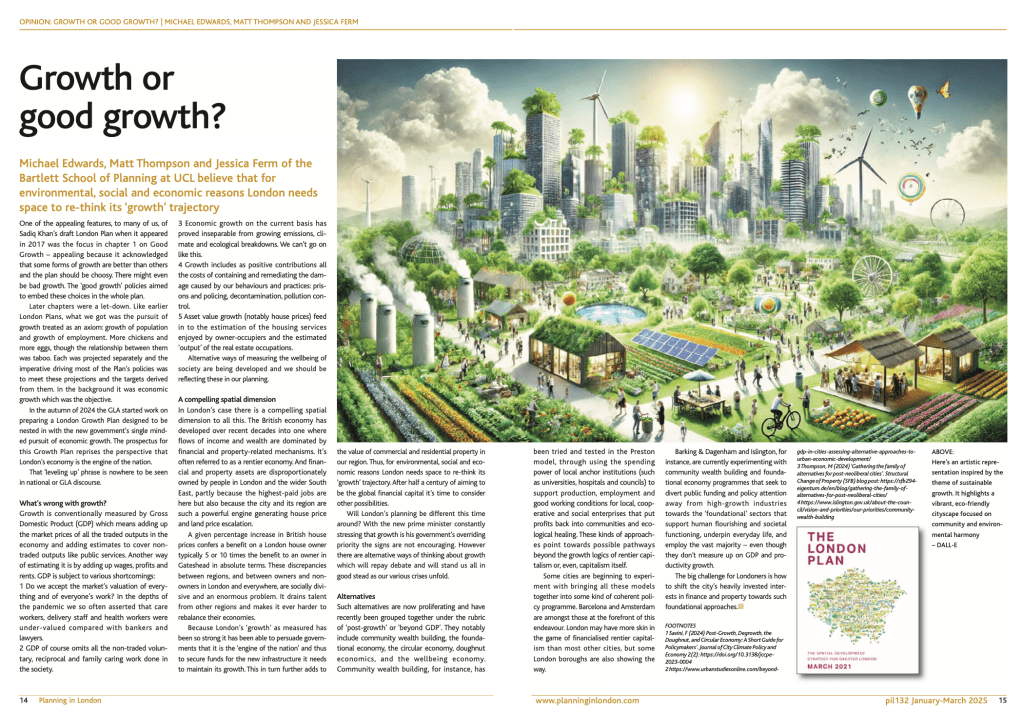
Here is an earlier article which I did with two colleagues, Jess Ferm and Matt Thompson which appeared in the January 2025 issue of Planning in London.

GLA London Growth Plan https://www.london.gov.uk/programmes-strategies/business-and-economy/mayors-priorities-londons-economy-and-business/london-growth-plan

UCL Bartlett research cluster on post-growth https://www.ucl.ac.uk/bartlett/planning/research-projects/2025/mar/post-growth-planning They are hosting an event on post-aviation futures on May 22 https://www.eventbrite.co.uk/e/airport-expansion-and-post-aviation-futures-tickets-1292559994739

Disciplines and comparative work

This blog post started as an abstract, put together in response to a plan by colleagues Susan Moore and Michael Short at the Bartlett in 2025 for a round table meeting on Critical Dialogues in Comparative Urbanism. The abstract was:

My enthusiasm for the project of dissolving disciplinary/professional boundaries in the Bartlett in the 1970s. Building student experiences to replace architecture, building and planning and knit a lot of ’science’ in the mix.

The highlights in my experience, notably the work of some individual students and the survival until [date] of the first year undergraduate module in which students studied the gestation of one London building and then took their methods on an overseas field trip

A research outcome in the Bartlett International Summer School on the Production of the built environment (BISS) which ran from 1979 to 1996, annual colloquium of scholars, trade unionists and a few activists built round an explicitly Marxist programme, leading to the International Network for Urban Research and Action INURA, founded in 1991 and still going strong as a network and annual meeting but never quite consummating its theoretical texts under the banner of The New Metropolitan Mainstream – though some of it appears in the work curated by Christian Schmid and Neil Brenner on Planetary Urbanism.

My personal effort from about 1990 to build BSP’s first new Masters programme European Property Development and Planning, initially parallelled by initiatives in Newcastle (Patsy Healey), Turin (Mazza, Ave), Venice (Folin) and … It struggled to become quorate for want of students with critical appetite but became a massive ’success’ as it later filled up with more business-oriented students from global elites and the newly capitalist countries. The international university partners faded away. UCL, BSP and many of the students got rich on the basis of what became IREP. A waste of 20 years, I think from my point of view.

The UCL School of Environmental Studies

When I joined UCL as a lecturer in 1969 Richard Llewelyn-Davies was in the process of forming a new department with this title by merging the Bartlett School of Architecture, the Department of Town Planning and various research units. Part of the project was to break out of the blinkered framework of professions, enabling teaching and research to draw on urban history, engineering (his original discipline) and other social and physical sciences. There was no particular orientation to international comparative study in this programme but the staff body included eminent people from European traditions of the Architect-Engineer: Bruno Schlaffenburg, planning officer of the new borough of Camden, Walter Bor who had been planning officer of Liverpool together with Ruth Glass, sociologist from Berlin and Duccio Turin. I was an enthusiast for all this, having just spent some years in my first job in the master planning team for Milton Keynes which was great mix of ‘disciplines’ and boundary-crossing. I wrote about the stirring atmosphere of the 1970s (and its defeat by resurgent professions) in the festschrift for historian Adrian Forty: Yes, and we have no dentists (2014).

The 1970s did not, for me, generate ideas about critical comparative study but we already did international field trips – always to Bologna – so a lot of comparative work went on, albeit without much explicit analysis.

Research: BISS

Through the 1980s, as neo-liberalism was extending its reach and penetration everywhere, some of us were developing critiques in the Bartlett International Summer Schools on the Production of the Built Environment BISS. This was an annual gathering of more-or-less Marxist and radical researchers, trade unionists and professionals in which class relations in the production process were centre-stage. Much of the work was international-comparative in scope developing explicit Marxist framings for this. It was captured in a 1985 book edited by Michael Ball, myself and others and recently reprinted. For just one or two memorable years we ran a Bartlett MSc on Production of the Built Environment, using this material. [The annual proceedings of Biss have been scanned by Jake Arnfeld and are now online at https://drive.google.com/drive/folders/1QwqDhyeiothvxt_Z5GVDiWjNhBSy2vVV]

Some of these ideas were revisited in a teach-out on Rent in 2019 and a reading group in 2021. The production-focused research continued in the work at the University of Westminster where Dr Linda Clarke moved from the Bartlett.

1990s: Roles and Relationships in the production of the built environment

The potentialities of international comparative study for teaching were most explicitly developed in a module which we ran through the 1990s, compulsory for all students in the Bartlett (now a faculty comprising departments with names like architecture, planning, construction). Fortunately it is well written up and preserved online though the journal in which it appeared is dead.

Research: INURA

As the BISS was wilting in the 1990s ascendancy of neo-liberalism, we launched a new network in which activism was meant to be as important as research: The International Network of Urban Research and Action INURA. Like the BISS it was headquartered in Switzerland and has annual meetings, though without its own scholarly publication. Its ‘method’ consists of a few days of listening and exploring in a host city with local activists, interspersed and followed with informal workshops which engage with the research and theoretical interests of participants. An attempt at publication of a systematic study of multiple cities has foundered as the unruly crowd of contributors failed to meet the high ambitions of the main leaders, notably Christian Schmid. Under the banner of The New Metropolitan Mainstream, some of it appears in the work curated by Christian Schmid and Neil Brenner on Planetary Urbanism. Most of the work sits like an iceberg on hard drives around the world. It contains valuable attempts to define variables and episodes common to multiple cities and thus generate principles for critical comparative study.

EPDP

My personal effort from about 1990 to build BSP’s first new Masters programme European Property Development and Planning, was initially paralleled by initiatives in Newcastle (Patsy Healey), Turin (Mazza, Ave), Venice (Folin) and ?? It struggled to become quorate for want of students with critical appetite but became a massive ’success’ as it later filled up with more business-oriented students from global elites and the newly capitalist countries. The international university partners faded away. UCL, BSP and many of the students got rich on the basis of what became IREP. A waste of 20 years, I think from the point of view of developing critical comparative analysis.

I thought of adding instances of students, and student dissertations, which have represented the achievement of these aspirations over the years. F

Adesope, G. (1993) Public-private relations in two major station redevelopments MPhil, London UCL compared the King’s Cross railway lands with Paris Rive Gauche, both ‘regeneration’ schemes above and around major stations and both hit by the same crash of the speculative office markets. The thesis examined how the London project evaporated while in Paris the municipality just kept on building decking, running up mounting public debt but harnessed the new Biblioteque Nationale to occupy some of the space.

Reference list

Edwards, M, Campkin, B and Arbaci, S (2009) Exploring roles and relationships in the production of the built environment Centre for Education in the Built Environment (CEBE) Transactions 6, 1, 10.11120/tran.2009.06010038 http://discovery.ucl.ac.uk/15579

Edwards, Michael (2014) “Yes, and We Have No Dentists.” In Forty Ways to Think About Architecture: architectural history and theory today, edited by Iain Borden, Murray Fraser and Barbara Penner, 280 pages. London: Wiley, ch 28, 2014. http://eu.wiley.com/WileyCDA/WileyTitle/productCd-1118822617.html
[
 e-print Edwards for Forty ]

Ball M J, Bentivegna, V, Edwards, M, and Folin, M, Eds (2018) Land Rent, Housing and Urban Planning: a European Perspective Reprint of 1985 book in Routledge Revivals series. https://www.routledge.com/Land-Rent-Housing-and-Urban-Planning-A-European-Perspective/Ball-Edwards-Bentivegna-Folin/p/book/9781138494435

2022, Michael Edwards, Harvey’s Urbanization of Capital: why it helped me so much, in Camilla Perrone (ed) Critical Planning & Design: Roots, pathways, and frames, pre-print as accepted: edwards-on-harvey-v1   Book now published. Details and ordering at http://link.springer.com/book/10.1007/978-3-030-93107-0…

BISS. https://drive.google.com/drive/folders/1QwqDhyeiothvxt_Z5GVDiWjNhBSy2vVV
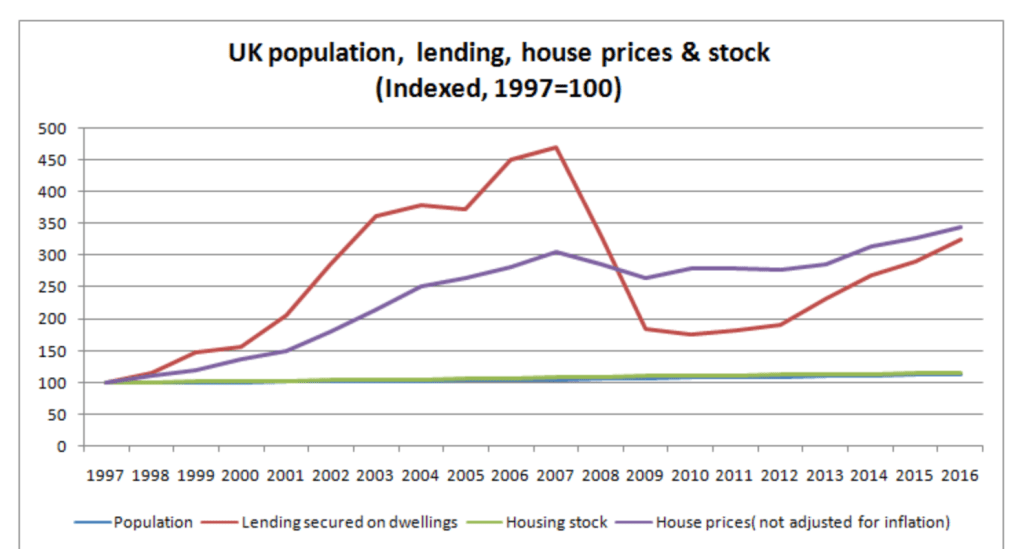
de-bunking build-build-build

blog today 29/11/23 via @explorerDale on Mastodon

Better view of the chart, without the cropping, here:

This picks up on an email I circulated to some colleagues a couple of weeks ago:

Those of you who were at yesterday’s zoom will recall a brief bit at the end when we spoke about the need for better short statements challenging the MUSTBUILDMOREANDMORE orthodoxy in English housing. I said I would make a start and hoped that others would join in. Please do comment or write…. If it takes off we’ll put it on a shared document [29/11 This is now at least visible and open to comments. We can make it a google document if people want.]

I had been triggered by talking with one of our new students who is also a Labour councillor in a London Borough. This is what I just sent him (anonymised)

I am just surfacing after a month dominated by moving house (& downsizing in the process from 6 rooms to 3). I guiltily realised that I never did reply to your request for reading / data suggestions on whether increasing the supply of dwellings, irrespective of price, would bring down the cost of housing in London. Aren’t there better ways of securing affordable housing, you asked? Your officers always insist…

It’s an important issue and the dominant orthodoxy has dominated London, and British, planning for decades. Challenges are mounting up  and I hope that other colleagues will join in giving the best possible answers. I’m going to circulate this to some allies (without your name) and hope we can build up a useful document.

For a start I would read this paper by a whole group of authors including our (Bartlett) Josh Ryan-Collins

Sophus O S E zu Ermgassen, M. P. Drewniok, J. W. Bull, C. M. Corlet Walker, M. Mancini, J. Ryan-Collins and A. Cabrera Serrenho (2022) “A home for all within planetary boundaries: Pathways for meeting England’s housing needs without transgressing national climate and biodiversity goals” Ecological Economics201: 107562 https://bit.ly/3AGgapU

Sections 1 and, especially 2, are a critique of English housing policy and the supply obsession. This is very up-to-date and useful. In my view the best short treatment of the issues.  

(The rest of this fascinating paper is about how the UK’s carbon budget would be gobbled up by anything approaching 300,000 homes a year nationally.)

Also very useful, and even more recent is this paper, not directly on your question but showing how supply-boosting government policies have tended to boost developer profits, not output

Foye, C. and E. Shepherd (2023) Why have the volume housebuilders been so profitable? The power of volume housebuilders and what this tells us about housing supply, the land market and the state, CaCHE, https://housingevidence.ac.uk/publications/why-have-the-volume-housebuilders-been-so-profitable/

Specifically on London, this is the position we (Just Space) took in 2016 and will now have to update for the new London Plan https://justspacelondon.files.wordpress.com/2017/12/js-response-to-housing-strategy-2017.pdf

Then appeared this article from the TCPA (whose journal is at last available online) Murray, C. and P. Phibbs (2023) “Evidence-lite zone: the weak evidence behind the economic case against planning regulation” Town Planning Review 94(6): 597-610

https://www.liverpooluniversitypress.co.uk/doi/10.3828/tpr.2023.24. It’s part of a whole issue which covers ‘resistance’ (to neo-liberalism)

If you have reached this point without finding the space to COMMENT it’s because you are reading this post as the current first item in the blog chain. Please go back to the top and click on the heading. That will put you on the same page as a free-standing object and there you will find the opportunity to COMMENT at the end of the page.

Bob Colenutt writes (1 December)

The Ryan Collins et al article is very powerful.  But I am still not quite clear about the dynamics however, particularly the spatial dynamics and I welcome further discussion. 

Agreed that price movements nationally clearly do not correlate neatly with supply,  and increases in supply do not make a significant impact on house prices.  The article points to overconsumption by those on higher incomes as one factor.  I would suggest that pricing strategies by housebuilders is another. But even so demand and supply relationships are at still at play though in in complex ways.  It seems to me at a local level, and in the second hand market that dominates prices, demand and supply are a factor in house price movements.  

Moreover, regional and  spatial variations in prices suggest that supply and demand are still very important.  The notion of a low demand area correlates with lower prices, and conversely a high demand area correlates with higher prices. This is not due only to spatial differences in wages and incomes but also due to variations in demand.  Housebuilders want to build in high demand areas foremost. 

The shortage of social rented homes is a matter of absolute shortage of these homes. So we don’t want to suggest in our messaging that more of these properties should not be built. Even if the PRS sector is reformed there will be still be a need for a lot more social rented homes, whatever happens to the private housing market.

Although I agree with the argument that more homes will not bring down prices at a national level of analysis, you can’t take demand and supply of houses out of the equation at a local level.  In Oxford we make the case for more housing not because it will bring down prices but because there is an absolute shortage of affordable homes.  It seems to me that the real problem is the lack of affordable homes not the number of homes built or on the market.  

However I do agree that national and local housing targets are pretty meaningless.  They do not equate with meeting housing need in a genuine sense and cannot ever satisfy market demand in booming areas like Oxford.  Nor can they meet demand for socially rented homes. But what I am not clear about from a policy point of view is the alternative.  If we say that the number of new homes is not the issue (in Oxford say) what is the supply side policy?  Are we saying it can found in the under-occupation, inefficiencies and inequalities in existing properties, and how do you tackle that?  Thus supply is an issue but only to found without as much new building. 

There are also issues about the quality of existing housing particularly its energy efficiency which again is not about targets of new supply but investment in current stock. Maybe we need a target for that. .

Anyway just some thoughts

Thank you for pursuing this!

all the best, Bob

Please do add material and/or comment below, or email m.edwards@ucl.ac.uk

Michael Edwards writes: an interim comment on Bob Colenutt, 5 December 2023

Bob I value this comment a lot and knitting it in to the rest of the argument and then boiling it down to short versions will be a good challenge. But my initial comments are:

  1. How can we argue that inadequate supply is not the sole or main cause of unaffordable housing when evidently supply/demand interactions do play some role? The public debates are so polarised that it’s easy to get driven in to over-simplification. The main answers are about time and space, by which I mean…
  2. SPACE: It helps to think of housing markets as whole sets of sub-markets, overlapping and inter-penetrating. The sub-markets are all to some extent potential substitutes for each other, for some buyers. (Flats for bungalows; Witney for Jericho, new for old). Changes in supply in a particular sub-market can have effects on prices in that sub-market which may ripple out to effect others. Developers (big ones) operate multiple ‘outlets’ (selling offices) and adjust their outputs in each to the level they think they will be able to sell annually without having to offer discounts or otherwise drop prices. And of course we know that house prices are determined across the whole stock, in which new construction may be around 1% per annum so, at best, a slow way to try to influence overall prices.
  3. TIME. Those who have tried to estimate how long it would take for increased housing supply in England to bring prices down. zu Ermgassen and others put it well in their §2: “Even if there are housing supply constraints, evidence suggests that expansion of the housing stock may have a limited effect on housing affordability. Estimates of the sensitivity of UK house prices to increases in housing stock consistently show that a 1% increase in housing stock per household delivers a 1–2% reduction in house prices (Auterson, 2014; Oxford Economics, 2016; MHCLG, 2018). This is minimal in the context of a 181% increase in mean English house prices from 2000 to 2020 (£84,620–£253,561; HMLR, 2022).”
    Of course the housing stock is an accumulation of buildings of various ages and many of the events which influence today’s prices for individual homes are long past: infrastructure networks, social infrastructures, designations like green belt and conservation areas. Many of these act over long periods. For example the rapid designation of conservation areas in England since the late 1960s has, de facto, almost frozen the supply of additional dwellings in the areas designated.

References cited in the quote:
Auterson, T., 2014. Forecasting House Prices (Working Paper No. 6). Office for Budget Responsibility.
HMLR, 2022. UK House Price Index – UK Land Registry https://landregistry.data.gov.uk/app/ukhpi/browse 
MHCLG, 2018. Analysis of the Determinants of House Price Changes. Ministry of Housing, Communities & Local Government, London.
Oxford Economics, J., 2016. Forecasting UK House Prices and Home Ownership (Report for the Redfern Review).

Last point, for the moment: nobody (tell me if I missed it) has integrated into the affordability analysis the effect of social class changes since the 1970s: the increase in income inequalities (fastest during Thatcher) wealth inequalities (very rapid more recently and itself both an effect and a cause of house price inflation) and shrinking of the social wage. No ‘market’ could possibly be expected to meet everyone’s housing needs in such a society and we should hypothesise that the housing provision system we have would be good at meeting the preferences of what they judge to be the asset-rich strata of society, and perhaps their children.

If you have reached this point without finding the space to COMMENT it’s because you are reading this post as the current first item in the blog chain. Please go back to the top and click on the heading. That will put you on the same page, but viewed as a free-standing object and there you will find the opportunity to COMMENT at the end of the page. (I think I have understood this.)

Equality & the London Plan

The GLA’s preliminaries to the production of the next London Plan (due to start after the May 2024 Mayor & Assembly elections) is well under way. Ordinary enthusiasts and campaigners are now permitted to apply for the meetings and the outcomes from earlier meetings are being posted on the same page.

I went to a meeting on Friday 24/11/23 about London’s Spatial Structure. A very white meeting and heavily steered. As we found last time (2016) the planners won’t accept anything as structural unless it shows on the map. Thus the severe structural inequalities which became so evident during lockdowns (and which the Mayor’s lockdown research stressed so well) were ruled out of scope. At the table I sat at there were some interesting exchanges about suburban densification, relations with surrounding regions (no longer taboo), opportunity areas. Nothing on overcentralisation or CR2… Our facilitator didn’t know how to deal with one very dull and verbose man, but otherwise OK.
At the end the chair asked what had been forgotten. I said growth /degrowth /growth of what? and raised some cheers.

On Monday I had a ticket for a session on”inclusive design” but now find I can’t go so have written to them about

Equality Impact

The main point I would have wanted to make is as follows. and I hope you can feed it in to the meeting or the write-up.

This meeting seems to be the only place where equality of impact considerations can even be squeezed in.

Your predecessors very correctly enlisted our network, Just Space, to the scoping discussions on Equalities Impact Assessment for the last London Plan but we really failed to reach any agreements. Then when the Draft Plan and its accompanying IIA appeared we were very critical of how it had been done. The Panel deliberated and considered that the GLA should release the detailed analysis which underpinned it. They did so. We found this almost as weak as the original for a whole variety of reasons and, again, persuaded the Panel. 

The panel insisted that the GLA went away and write a serious paper on how each policy would impact on each protected group.

The resulting paper, some weeks later was highly informative, making it clear how in so many respects this plan would be good for richer people and less good, or bad for poor people (and thus many protected groups who share disproportionately in poverty). This was a devastating critique of the plan but the Panel ticked its box for job done and moved on. Had this study been prepared at the proper time —early enough to assist the evolution of the plan— the Plan would have been much fairer.

We are very keen to ensure that this fiasco is not repeated next year. The main aim is to get a better plan which would better serve poorer and minority and disabled Londoners.

A first step would be you discussing this with groups representative of (and run by) the principal protected groups to develop shared understandings of what works for them, drawing also on research evidence. I hope that your efforts last autumn to meet controled and representative samples of Londoners has enabled you to do this, or at least have the necessary database of contacts.

Just Space has not yet put together its positions for the next Plan but we can be sure that these considerations will be to the fore.

Best wishes,  Michael Edwards, Just Space and UCL

Note: I hope we can start pooling these notes on the Just Space web site from people who have attended.